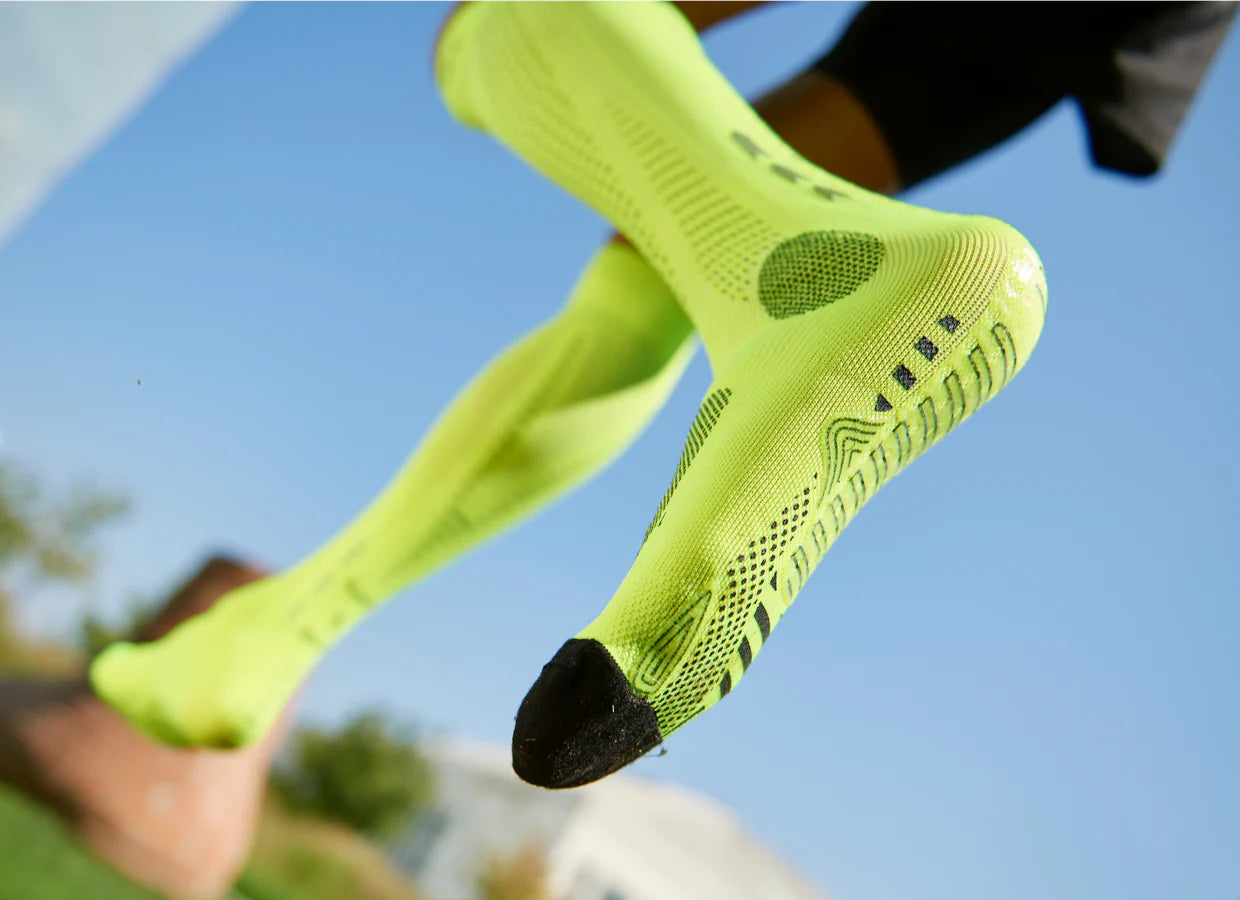
Running is one of the simplest forms of exercise. You put on your shoes, head out the door and start moving.
Simple, yes. Easy on the body? Not always.
Every stride sends force through your feet, ankles, calves, shins, knees, hips and lower back. When your body is prepared for that load, running can feel smooth, strong and almost effortless. When the load builds faster than your body can tolerate, discomfort can start to appear.
That is why running injuries are so common.
For some runners, it starts as shin pain during a new training block. For others, it is knee discomfort on hills, calf tightness after speed work, Achilles irritation after increasing distance, or foot pain that slowly becomes harder to ignore.
Running injuries can happen for many reasons, including training load, fatigue, footwear, strength, recovery and movement mechanics. Support gear is not a cure and it is not a replacement for medical advice. But the right compression and support products may help runners feel more comfortable, stable and confident during movement.
At Floky, we approach support through the lens of biomechanics. That means looking at how the body moves as a connected system, rather than treating each area in isolation.
For runners, that matters.
Why Running Injuries Happen
Most running injuries are not caused by one single bad step. They are usually linked to repeated load building up over time.
Running is repetitive. If you run five kilometres, your body may take thousands of steps. Each step asks your foot, ankle, shin, calf, knee, hip and core to absorb force, stabilise and push you forward again.
When the body is ready for that demand, it adapts. When the demand increases too quickly, certain areas can become overloaded.
Common contributors to running injuries include:
-
Increasing distance too quickly
-
Running too often without enough recovery
-
Adding speed work or hills suddenly
-
Running on hard surfaces
-
Wearing shoes that are worn out or not suited to your body
-
Returning to running after time off
-
Fatigue changing your running form
-
Weakness through the calves, glutes, hips or core
-
Poor load management
-
Ignoring early warning signs
-
Not allowing enough time for recovery
A common pattern is doing too much, too soon.
That might mean jumping from two runs per week to five. It might mean adding hills, intervals and a long run all in the same week. Or it might mean returning to running after a break and expecting your body to tolerate what it did months or years ago.
The body is usually willing to adapt. It just does not love being ambushed.
Common Running Injury Areas
Running injuries can show up in different parts of the body, depending on your training, movement patterns, footwear, strength and recovery.
Some of the most common problem areas for runners include:
| Injury Area | Common Runner Complaint | Why It Can Happen | Relevant Floky Support |
|---|---|---|---|
| Shin and lower leg | Shin pain, shin splints, lower-leg stress | Increased volume, hard surfaces, calf fatigue | Floky compression socks |
| Knee | Runner’s knee, patella discomfort, instability | Repeated impact, hills, fatigue, poor control | Knee Support Knee Brace |
| Calf and Achilles | Calf tightness, Achilles irritation | Push-off load, hills, speed work, sudden training changes | Compression socks / HYPER leggings |
| Foot and arch | Foot fatigue, heel or arch discomfort | Repeated impact, footwear, calf tightness | Compression socks |
| Hip and glutes | Hip tightness, glute fatigue, poor stability | Weakness, fatigue, poor pelvic control | HYPER Man / HYPER Woman Leggings |
| Lower back | Back tightness or strain | Fatigue, poor trunk control, overstriding | HYPER leggings / strength and recovery |
| Arm and elbow | Arm tension or forearm fatigue | More relevant for hybrid athletes | No Strain Sleeve |
Support gear can be useful, but the best option depends on where you feel the most load and what type of movement you want to support.
Shin Pain and Lower-Leg Stress
Shin pain is one of the most common issues runners search for, especially during beginner running plans, return-to-running phases or higher-volume training blocks.
Many runners describe it as aching, tightness or discomfort along the front or inside of the shin. It may show up early in a run, build as the session continues, or feel worse after increasing distance, speed or frequency.
Shin pain is often linked to repetitive lower-leg stress, but the exact cause can vary.
Common contributing factors include:
-
Increasing running volume too quickly
-
Running on hard surfaces
-
Adding hills or speed work too suddenly
-
Calf fatigue
-
Returning to running after time off
-
Footwear changes
-
Reduced strength or control through the feet, calves, hips or glutes
This is where Floky compression socks can be a useful support option.
Compression socks may help runners feel more supported through the calf and shin area. They can provide a firm, secure feeling through the lower leg, which may help with comfort and confidence during movement.
They will not “fix” shin pain on their own. If your training load is too high, your body still needs recovery and adaptation. But compression socks can form part of a smarter support strategy for runners who want lower-leg comfort and control.
Runner’s Knee and Knee Pain
Knee pain is another common issue for runners.
The knee absorbs and transfers force with every stride. It is also heavily involved when running hills, descending, changing pace or training through fatigue.
Runners may experience:
-
Front-of-knee discomfort
-
Patella-area soreness
-
Discomfort around or behind the kneecap
-
Stiffness after running
-
Pain during hills or stairs
-
A feeling of reduced stability
-
Reduced confidence when loading the joint
The knee does not work alone. It is influenced by what happens above and below it.
Your foot strike, ankle control, calf capacity, hip strength, glute control, stride length and fatigue levels can all affect how your knee feels when you run.
For runners wanting targeted knee support, the Floky Knee Support Knee Brace is the key product fit.
The Knee Support Knee Brace is designed to support the knee and patella during movement. For runners, it may help create a more secure, supported feeling around the joint.
Knee support may provide compression, warmth and proprioceptive feedback. Proprioception is your body’s awareness of where it is in space. In practical terms, it may help you feel more aware of your knee position as you move.
That said, knee support should not be used to push through pain that is sharp, worsening or changing your running style. If pain persists, it is worth speaking with a physiotherapist, doctor or qualified health professional.
Calf and Achilles Load
The calves and Achilles do a huge amount of work during running.
Every stride asks the calf complex to help absorb force and push the body forward. Hills, speed work, forefoot running and sudden increases in training can all increase the load through this area.
Common signs of calf or Achilles overload may include:
-
Calf tightness
-
Achilles stiffness
-
Soreness after hills
-
Discomfort during speed work
-
Tightness first thing in the morning
-
Fatigue during longer runs
-
A heavy or overloaded lower-leg feeling
For runners who want lower-leg support, Floky compression socks are the first product to consider.
They can provide a supportive compression feel through the calf and lower leg, which may be useful during training, longer sessions or recovery-focused use.
For broader support, the HYPER Man Leggings and HYPER Woman Leggings may also be relevant. These provide full lower-body compression and are designed for stability and recovery support across the legs, knees, glutes and surrounding muscle groups.
A simple way to think about it:
-
Choose compression socks if your main focus is calf, shin or lower-leg support.
-
Choose HYPER leggings if you want broader lower-body compression, stability and recovery support.
Foot Pain and Foot Fatigue
The foot is the first point of contact with the ground, so it plays a major role in running comfort.
Some runners experience heel pain, arch discomfort, forefoot irritation or general foot fatigue. This can be linked to training load, footwear, calf tightness, foot strength, running surface or changes in activity.
Common contributors include:
-
Increasing running too quickly
-
Worn-out or unsuitable shoes
-
Tight calves
-
Weakness through the feet or lower leg
-
Running on hard surfaces
-
Returning after time away
-
Fatigue changing foot strike or control
Foot pain should be taken seriously, especially if it persists or worsens. Support gear may help with comfort, but ongoing foot pain should be assessed properly.
Floky compression socks can be useful as part of a broader lower-leg support strategy. While they are not a treatment for foot injuries, they may help runners feel more supported through the lower-leg chain, including the calf, shin and ankle area.
Hip, Glute and Lower Back Issues
Running is not just a lower-leg sport.
The hips, glutes and lower back are heavily involved in controlling posture, stabilising the pelvis and helping the body absorb force efficiently.
When runners fatigue, increase distance too quickly or lack strength through the hips and glutes, the body may start to compensate. That can contribute to tightness or discomfort through the hips, glutes or lower back.
Common issues may include:
-
Hip tightness
-
Glute fatigue
-
Lower back stiffness
-
Reduced stability late in runs
-
Overstriding
-
Poor trunk control
-
Difficulty maintaining form over longer distances
This is where broader lower-body support can be useful.
The HYPER Man Leggings and HYPER Woman Leggings are designed for full lower-body compression, stability and recovery support. They may be a strong option for runners who want support across the legs, knees, glutes and surrounding muscle groups.
They are not a replacement for strength work, but they can be part of a broader running support and recovery routine.
For runners, strength still matters. Calves, quads, hamstrings, glutes, hips and core all help the body tolerate repeated impact.
Compression can support the system. Strength builds the system.
The Biomechanics of Running Injuries
Running injuries are often felt in one area, but the body moves as a connected chain.
Every stride involves:
-
Foot strike
-
Ankle control
-
Calf loading
-
Shin and lower-leg stress
-
Knee stability
-
Hip control
-
Glute activation
-
Core positioning
-
Arm swing
If one part of the chain is not coping well, another area may take more load.
For example:
-
Calf fatigue may increase lower-leg stress
-
Poor hip control may affect knee position
-
Overstriding may increase impact forces
-
Weak glutes may affect pelvic stability
-
Hard surfaces may increase repeated loading
-
Fatigue may change running form
This is why biomechanics matters.
Biomechanics looks at how the body moves, absorbs force and maintains control. For runners, that means understanding that the shin, knee, calf, hip and foot are all connected.
Standard compression focuses mostly on pressure. Biomechanical compression considers how support interacts with movement.
That is Floky’s point of difference.
Floky support is designed around the way athletes move, not just compression for compression’s sake.
Which Floky Support Fits Which Running Need?
The best support product depends on where you feel the most load and what type of support you are looking for.
For Shin Pain and Lower-Leg Stress: Floky Compression Socks
Floky compression socks are the hero product for runners wanting support through the calf, shin and lower-leg area.
They may be useful for:
-
Shin discomfort
-
Lower-leg fatigue
-
Calf tightness
-
Hard training blocks
-
Longer runs
-
Recovery-focused use
-
Runners wanting a more supported lower-leg feel
For Knee Discomfort: Knee Support Knee Brace
The Knee Support Knee Brace is designed for targeted support around the knee and patella.
It may be useful for runners wanting support during:
-
Easy runs
-
Return-to-running phases
-
Hill running
-
Gym-to-run training blocks
-
Sessions where the knee feels less confident
-
Movement where extra knee support feels helpful
For Broader Lower-Body Support: HYPER Man and HYPER Woman Leggings
The HYPER Man Leggings and HYPER Woman Leggings provide full lower-body compression, stability and recovery support.
They may be useful for runners who want:
-
Full-leg compression
-
Broader support across the legs
-
Knee and glute support
-
Recovery-focused compression
-
Support during heavy training weeks
-
Stability-focused support during sport and training
For Hybrid Athletes: No Strain Sleeve
The No Strain Sleeve is not a core running injury product, but it can be relevant for runners who also train in the gym, play racquet sports, do CrossFit or complete other upper-body activities.
It is designed to provide biomechanical compression through the elbow and forearm area.
For pure running, it is a secondary product. For hybrid athletes, it may be a useful support option.
Running Injury Prevention Basics
Support gear can help, but running injury prevention starts with training habits.
If you run regularly, these basics matter.
Build Gradually
Avoid sudden jumps in distance, speed, hills or frequency. Your body needs time to adapt to new loading.
A gradual build is not exciting, but neither is being injured. The boring option wins here.
Rotate Easy and Hard Days
Not every run should be hard. Easy days help you build volume without constantly stressing the body.
Hard sessions, hills and long runs all need recovery around them.
Strength Train
Strength work helps your body tolerate running load.
Useful areas to train include:
-
Calves
-
Quads
-
Hamstrings
-
Glutes
-
Hips
-
Feet
-
Core
For runners, strength training is not optional decoration. It is part of the foundation.
Warm Up Before Hard Sessions
Easy runs may only need a gentle start, but faster sessions and hills deserve a proper warm-up.
Include dynamic movement, light jogging and a few progressive efforts before harder running.
Pay Attention to Footwear
Shoes do not solve everything, but they matter.
Worn-out or unsuitable shoes can contribute to discomfort for some runners. Choose shoes that suit your running style, surface and comfort needs.
Recover Properly
Sleep, nutrition, hydration and rest all affect how well your body adapts to training.
Compression products such as Floky socks and HYPER leggings may also be used by some runners as part of their recovery routine.
Listen to Early Warning Signs
Small discomfort can often be managed early. Ignored discomfort has a habit of becoming louder, like a toddler with a tambourine.
If pain is getting worse, changing your stride or not settling, reduce load and seek advice.
When to Seek Professional Advice
Running discomfort is common, but pain should not be ignored.
Speak with a doctor, physiotherapist or qualified health professional if you experience:
-
Sharp or sudden pain
-
Pain that worsens during a run
-
Pain that changes your running style
-
Pain that continues after stopping
-
Swelling
-
A joint that feels unstable
-
Pain that affects walking
-
Pain that returns every time you run
-
Pain after a fall, twist or impact
-
Symptoms that do not improve with rest or support
Support gear can be part of your running toolkit, but it should not be used to push through pain that needs proper assessment.
Final Thoughts
Running injuries often come from repeated load, sudden training changes, fatigue or movement issues.
The most common problem areas for runners include the shins, knees, calves, Achilles, feet, hips and lower back. While each area may feel separate, the body works as one connected system.
That is why biomechanics matters.
Floky’s approach to compression and support is designed around movement. Instead of focusing only on pressure, Floky looks at how support can help athletes feel more comfortable, stable and confident while they move.
For lower-leg support, explore Floky compression socks. For targeted knee support, consider the Knee Support Knee Brace. For broader lower-body compression, stability and recovery support, explore the HYPER Man Leggings and HYPER Woman Leggings.
Running should feel strong, confident and sustainable.
Floky is built to support the way you move.