Pickleball can feel more approachable than many racquet sports. The court is compact, the serve is underarm and doubles rallies often reward placement more than outright speed.
That does not make the sport physically undemanding.
Players still accelerate, brake, change direction, reach for low balls and repeat hundreds of paddle strokes. A short sprint towards the kitchen line can load the calves and Achilles tendon, while a late change of direction can challenge the ankle or knee. Repeated gripping and hitting can irritate the forearm and elbow. A loss of balance can turn an ordinary rally into a wrist, hand or shoulder injury.
The result is a mix of acute injuries, which happen in a specific moment, and overuse injuries, which build gradually when playing load exceeds the body's current capacity.
This guide explains the most common pickleball injuries, the symptoms that should not be ignored and practical ways to reduce risk. It also shows where supportive Floky products may fit—and where a sleeve or sock is not a substitute for assessment, rehabilitation or protective equipment.
Important: This article provides general information, not a diagnosis or personalised medical advice. Seek professional assessment for severe, persistent or worsening symptoms, or after a significant fall or sudden injury.
Pickleball injuries at a glance
| Injury or problem | Common pattern | Typical warning signs | Relevant Floky support |
|---|---|---|---|
| Wrist or hand injury | Fall onto an outstretched hand; repeated gripping | Pain, swelling, bruising, reduced grip or movement | No dedicated wrist brace; NO STRAIN supports the forearm, not the wrist joint |
| Pickleball elbow | Repeated gripping and wrist extension | Outer-elbow pain, weak grip, pain when lifting or hitting | NO STRAIN Sleeve |
| Shoulder pain | Repeated overhead strokes, reaching or a fall | Pain when raising the arm, weakness, night pain | No dedicated shoulder brace |
| Ankle sprain | Rolling the ankle during a stop, lunge or change of direction | Pain, swelling, bruising or instability | S-MASH 3D for in-shoe grip and foot support; not an ankle brace |
| Calf strain | Sudden push-off or backwards movement | Sharp calf pain, tightness, weakness or bruising | S-MASH 3D during play; RE-CHARGE after play when appropriate |
| Achilles pain or rupture | Repeated acceleration or sudden forceful push-off | Gradual tendon pain, or a sudden pop with loss of push-off | S-MASH 3D for support; urgent assessment for suspected rupture |
| Knee pain | Braking, twisting, lunging or accumulated load | Swelling, catching, giving way or pain on stairs and court | ACTIVATOR supports hips and thighs; it is not a knee brace |
| Hip, groin or hamstring strain | Wide lunges, rotation and sudden acceleration | Local pain, tightness, weakness or reduced stride | ACTIVATOR Shorts |
| Foot and plantar-arch pain | Repeated court loading, unsuitable footwear or rapid load increase | Heel or arch pain, focal tenderness, pain during push-off | S-MASH 3D; RE-CHARGE after play |
How common are pickleball injuries?
The research base is still developing, and emergency-department studies capture the injuries serious enough to require hospital care—not every sore elbow or tight calf at the local club.
Even with that limitation, the available evidence highlights several important patterns. A 10-year analysis of US emergency-department presentations found that falls accounted for 65.5% of recorded pickleball injuries. Fractures and sprains or strains were the leading diagnoses, and the wrist was the most frequently injured body area. The authors also found that lower-leg and ankle injuries were common among strain and sprain presentations. Read the study in the Orthopaedic Journal of Sports Medicine
Another large analysis found that players aged 60 to 79 had higher odds of wrist or hand injuries, fractures and fall-related injuries than younger groups. View the PubMed record
This does not mean older adults should avoid pickleball. The sport offers movement, skill development and a strong social component. It does mean that balance, strength, footwear, progressive exposure and fall awareness deserve as much attention as paddle choice.
1. Wrist and hand injuries
Wrist injuries are among the most important pickleball injuries to understand because they can occur in two very different ways.
Repetitive wrist pain
Repeated gripping, late ball contact, excessive wrist movement or a rapid increase in playing volume may gradually irritate tissues in the wrist and forearm. Symptoms may begin as an ache after play and progress to pain during volleys, drives, serves or everyday gripping.
Equipment and technique can contribute. A grip that is too small may encourage excessive squeezing, while a paddle that feels heavy or difficult to control can increase demand through the hand and forearm. However, simply buying a lighter paddle is not a complete treatment plan if pain is already established.
Wrist injury after a fall
A fall onto an outstretched hand can sprain a wrist, tear a ligament or cause a fracture. The American Academy of Orthopaedic Surgeons notes that even an apparently mild wrist injury can involve a significant ligament tear or a hidden fracture. Persistent pain after a fall therefore deserves assessment rather than a self-diagnosis of “just a sprain”. AAOS wrist-sprain guidance
Seek prompt help if there is:
-
Visible deformity
-
Significant swelling or bruising
-
Numbness, tingling or cold fingers
-
Marked tenderness over one point
-
Difficulty gripping or moving the wrist
-
Pain that does not improve quickly after a fall
Floky's NO STRAIN Sleeve covers the elbow and forearm and may support the muscles that act on the wrist. It is not a rigid wrist brace, wrist guard or fracture protection. Do not use it to continue playing after an acute wrist injury.
2. Pickleball elbow
“Pickleball elbow” generally refers to lateral epicondylitis—the same condition commonly called tennis elbow. It affects the forearm tendon on the outside of the elbow and is associated with repeated wrist and finger extension.
Symptoms usually develop gradually and may include:
-
Pain or burning on the outside of the elbow
-
Tenderness around the outer elbow
-
Reduced grip strength
-
Pain when lifting a kettle, opening a jar or carrying a bag
-
Pain during backhands, volleys or forceful paddle strokes
The condition is not necessarily caused by one technically poor shot. A sudden jump from one casual game each week to several long sessions can be enough to exceed the tendon’s current tolerance. Paddle setup, grip pressure, stroke mechanics and limited forearm capacity may add to the problem.
AAOS guidance describes activity modification and progressive forearm exercise as common parts of non-surgical management. A forearm brace may reduce symptoms for some people, but support should accompany appropriate load management and rehabilitation. AAOS tennis-elbow guidance
Where NO STRAIN may fit
The NO STRAIN biomechanical sleeve uses targeted compression and external applications around the elbow and forearm. It is designed to improve stability and manage vibration during sports movement.
That makes it the most relevant Floky option for players seeking broad forearm and elbow support during pickleball. It should not be described as a cure for tendinopathy, and feeling more comfortable in a sleeve does not automatically mean the tendon is ready for unrestricted play.
3. Shoulder injuries
Pickleball strokes are generally less overhead-dominant than tennis serves, but the shoulder still contributes to serves, smashes, drives, reaching volleys and deceleration after the shot. Repeated play can aggravate the rotator cuff or other shoulder structures, particularly when technique deteriorates with fatigue.
Shoulder injury may also follow a fall. Landing directly on the shoulder is different from gradual post-match soreness and may cause a fracture, dislocation or significant soft-tissue injury.
Reduce play and seek assessment if you notice:
-
Painful weakness when lifting the arm
-
A sudden loss of movement
-
A feeling that the shoulder slipped out
-
Night pain that is persistent or worsening
-
Pain following a direct fall
-
Numbness or tingling into the arm
Floky does not currently offer a dedicated shoulder brace in its pickleball collection. NO STRAIN supports the elbow and forearm; it should not be positioned as treatment for a rotator-cuff, labral or other shoulder injury.
4. Ankle sprains
Pickleball involves repeated split steps, side-to-side movement and rapid braking close to the non-volley zone. An ankle may roll when a player reaches outside their base of support, changes direction late, steps on another foot or plays in unsuitable shoes.
Common signs include pain, swelling, bruising, tenderness and a feeling that the ankle is unstable or giving way. Severe sprains and fractures can look similar, so difficulty bearing weight or marked bony tenderness warrants assessment. AAOS ankle-sprain guidance
Footwear and sock choice
USA Pickleball recommends court shoes because running shoes are not designed to provide the same support for repeated side-to-side movement. It also highlights warm-ups, balance work and strength training as practical safety measures. USA Pickleball Health & Safety Hub
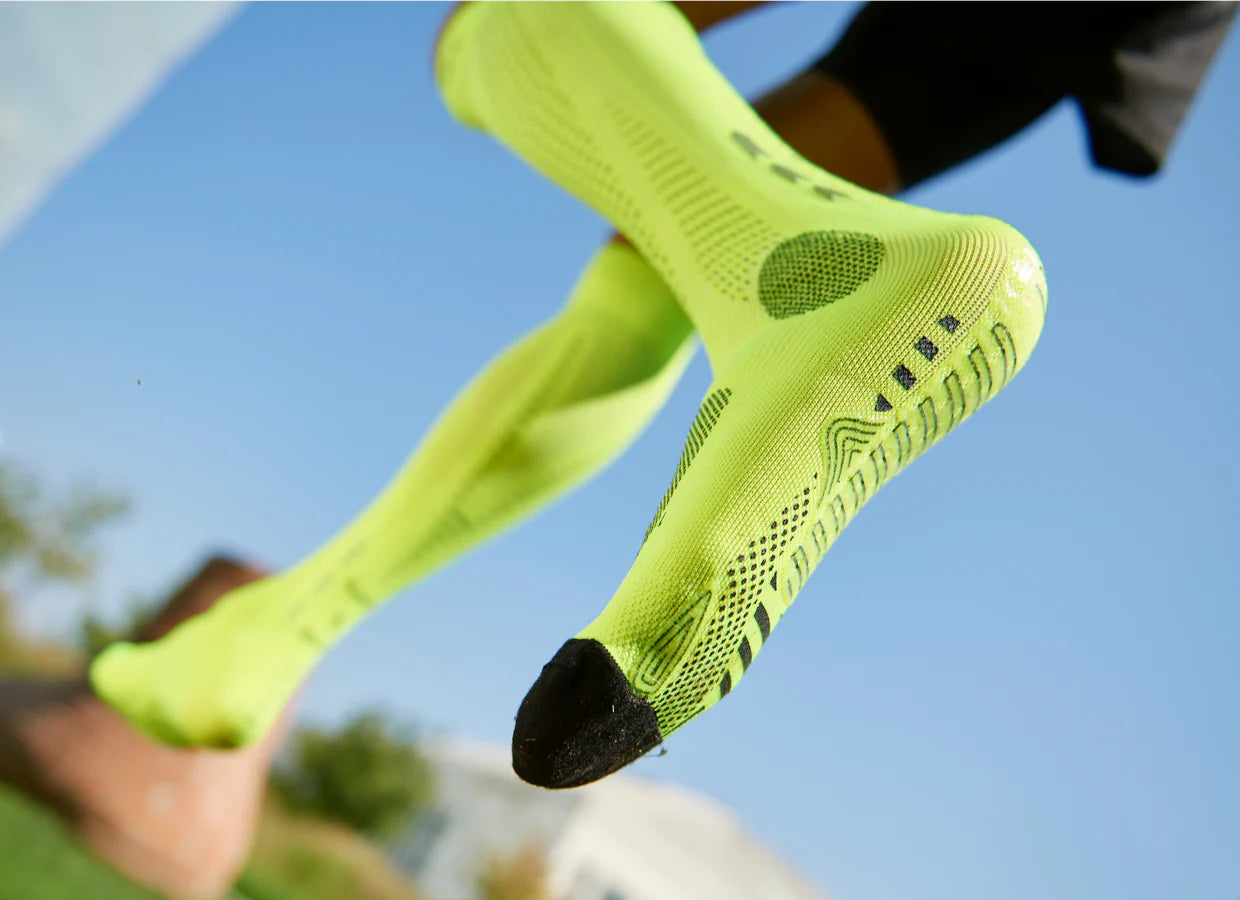
The S-MASH 3D Sock is designed specifically for racquet sports. Its ribbed construction and cushioning are intended to improve grip, comfort and stability between the foot and shoe, while targeted features support the plantar arch and Achilles area.
That may help create a more secure in-shoe feel during changes of direction. It cannot stop every ankle roll and is not equivalent to an ankle brace, taping or rehabilitation for an unstable ankle.
5. Calf strains and Achilles injuries
The first few steps towards a short ball can be deceptively demanding. A forceful push-off lengthens and loads the calf-Achilles unit quickly, particularly when a player is moving forwards from a relatively upright starting position.
Calf strain
A calf strain may feel like a sudden pull, sharp pain or kick to the back of the lower leg. Mild strains can cause tightness and reduced power; more substantial injuries may cause swelling, bruising and difficulty walking or pushing onto the toes.
Risk may increase when a player:
-
Returns after a long break
-
Plays several sessions close together
-
Starts without a progressive warm-up
-
Is fatigued late in a session
-
Has not developed calf strength for repeated acceleration and braking
Achilles tendinopathy
Achilles tendinopathy more often develops gradually. Morning stiffness, pain at the back of the heel or tendon, discomfort that worsens with activity and increased soreness the following day can all be warning signs.
Continuing to add games while symptoms steadily worsen is rarely a clever negotiation with a tendon. Reduce the aggravating load and seek guidance on progressive rehabilitation.
Achilles rupture
A rupture is an acute injury. Warning signs include a pop, severe pain or swelling near the heel, inability to walk normally or inability to rise onto the toes of the injured leg. A suspected rupture needs urgent assessment. AAOS Achilles-rupture guidance
S-MASH 3D provides targeted support around the foot, arch and Achilles during play. The RE-CHARGE Sock is Floky's recovery-specific full-length sock for the foot, calf and lower leg after training or competition. Neither product should be used to mask a new calf tear or suspected Achilles rupture.
6. Knee injuries and knee pain
The knee absorbs force during lunges, stops and changes of direction. Symptoms can arise gradually through repeated loading or acutely during a twist or awkward landing.
Not all knee pain has the same cause. Tendons, ligaments, cartilage, menisci and the joint surfaces can all produce symptoms. That is why a product-first diagnosis—“my knee hurts, so I need compression”—is not enough.
Seek assessment for:
-
Significant swelling
-
A knee that locks or catches
-
Repeated giving way
-
Inability to fully straighten the knee
-
Pain after a clear twisting injury
-
Inability to bear weight normally
Floky's ACTIVATOR Shorts provide graduated compression and targeted support around the hips, glutes, thighs and hamstrings. Supporting these areas may help a player feel more stable during court movement, but ACTIVATOR is not a knee sleeve or ligament brace.
7. Hip, groin and hamstring strains
Wide lateral reaches, low positions and sudden changes from braking to acceleration can load the muscles around the hips and thighs. A strain may occur suddenly or build from repeated sessions with inadequate recovery.
Common signs include local pain, tightness, weakness and discomfort when lengthening or contracting the affected muscle. Bruising, a sudden pop or difficulty walking suggests a more significant injury.
ACTIVATOR Shorts are the Floky product most directly aligned with this area. They are designed to provide biomechanical support and compression through the upper legs, glutes and hips and can be worn beneath standard pickleball clothing.
Test the fit in training before wearing them in a tournament. Compression should feel firm without restricting lunges, rotation or normal circulation.
8. Foot, heel and plantar-arch pain
Foot discomfort can develop when court time increases faster than the foot and lower leg can adapt. Court shoes that do not fit correctly, worn cushioning, repeated hard-surface sessions and limited calf or foot capacity may contribute.
Players may notice:
-
Heel pain during the first steps after rest
-
Arch pain or fatigue
-
Forefoot discomfort during push-off
-
Blisters or hot spots
-
Focal bony tenderness
Focal pain over a bone, swelling or pain that worsens with weight-bearing should not be dismissed as ordinary soreness. Stress injuries can develop gradually and require an appropriate diagnosis.
S-MASH 3D combines enhanced in-shoe grip with cushioning and plantar-arch support for court play. Correct sizing matters: a supportive sock cannot rescue a shoe that is too narrow, too loose or wrong for the surface.
Why are older pickleball players at greater risk of some injuries?
Pickleball's accessibility is one of its strengths, but the sport can tempt people to progress more quickly than their bodies are prepared for. A player may have the skill and coordination to rally on day one without yet having the calf capacity, balance or braking strength needed for repeated competitive sessions.
Age alone does not determine injury. However, changes in balance, reaction time, muscle power and bone density can make falls more consequential. Previous injuries, osteoarthritis, medications and a long break from exercise may also influence risk.
Older or returning players should consider:
-
Starting with shorter sessions and more recovery days
-
Building lower-body strength and balance away from the court
-
Learning safe movement and stopping patterns with a coach
-
Avoiding unnecessary backwards running for overhead balls
-
Wearing court-specific shoes
-
Discussing bone health or significant medical concerns with a qualified professional
How to reduce the risk of pickleball injuries
No warm-up, sock or strength program can guarantee an injury-free season. The aim is to reduce avoidable risk and improve the body's capacity for the sport.
1. Increase court time gradually
Avoid moving from little activity to several long sessions in one week. Increase one variable at a time—frequency, duration or intensity—and watch how your body responds over the following 24 to 48 hours.
2. Use a progressive warm-up
Start with easy movement to raise body temperature, then practise the patterns you will use on court.
A simple sequence may include:
-
Three to five minutes of brisk walking, cycling or easy jogging
-
Ankle rocks and controlled calf raises
-
Squats or sit-to-stands
-
Lateral steps and gentle changes of direction
-
Shoulder circles and easy paddle swings
-
Short-court rallies before full-speed drives or overheads
A warm-up is preparation, not a pre-match flexibility exam. Movement should become progressively faster and more specific.
3. Strengthen the whole movement chain
Useful training areas include:
-
Calves for push-off and deceleration
-
Quads, hamstrings and glutes for lunging and braking
-
Single-leg balance for court control
-
Trunk strength for force transfer
-
Shoulder and upper-back muscles for paddle control
-
Forearm muscles for repeated gripping and wrist stability
Exercise selection should match your current health, experience and any existing injury.
4. Wear court shoes
Court shoes are designed for lateral movement and repeated stopping. Running shoes are mainly built for forward motion and may not provide the same side-to-side stability.
Replace shoes when the outsole has worn smooth, the upper no longer secures the foot or the midsole feels compressed and uneven.
5. Review paddle and grip setup
A coach or knowledgeable fitter can help assess paddle weight, grip circumference and technique. Try not to squeeze the handle harder than the shot requires. A death grip is useful only if the paddle has personally wronged you.
6. Train balance and fall awareness
Balance work may be particularly helpful for older players and anyone returning after time away. Learn to turn and move for a lob rather than backpedalling blindly. Keep the court clear of loose balls and communicate when partners move into the same space.
7. Manage fatigue, heat and hydration
Technique and decision-making often deteriorate as fatigue rises. Take breaks, drink appropriately and modify session length in hot conditions. Dizziness, confusion, faintness or unusual weakness are reasons to stop—not signs that you need to win one final game.
8. Respond to early warning signs
An isolated mild ache that settles quickly may simply need monitoring. Pain that escalates during play, changes your movement, reduces strength or remains worse the following day suggests that the current load may be too high.
Choosing Floky gear for pickleball
Floky gear is best viewed as supportive equipment within a broader preparation and recovery plan.
For elbow and forearm support: NO STRAIN
Choose NO STRAIN when broad compression and targeted support around the elbow and forearm are the priority. It may be useful during repeated paddle strokes, especially for players who prefer a sleeve rather than a narrow counterforce strap.
For foot stability and court movement: S-MASH 3D
Choose S-MASH 3D for a court-specific sock with enhanced grip, cushioning, plantar-arch support and targeted Achilles support. It is intended to improve the interface between foot and shoe during intense movement.
For hips, glutes and thighs: ACTIVATOR Shorts
Choose ACTIVATOR Shorts when upper-leg compression and support are the priority. They can sit beneath pickleball shorts, a dress or a skirt, provided the combination remains comfortable and unrestricted.
For post-match lower-leg support: RE-CHARGE
Change into RE-CHARGE Socks after play when recovery-focused compression for the feet, calves and lower legs is the goal.
None of these products guarantees injury prevention. They also do not replace a wrist guard, ankle brace, knee brace or medical treatment when one of those is clinically indicated.
Returning to pickleball after an injury
Return-to-play timing depends on the tissue injured and the severity of the problem. A useful progression is:
-
Daily activities are comfortable.
-
Strength and range of motion are adequate for the injured area.
-
Basic court movement is tolerated without a symptom flare.
-
Controlled hitting is reintroduced.
-
Session duration and movement intensity increase gradually.
-
Practice games come before unrestricted competition.
Do not judge readiness only by how the area feels while warm or compressed. The response later that day and the following morning is also valuable.
For fractures, significant sprains, tendon ruptures, surgery, concussion or persistent joint instability, follow the return-to-play guidance of the treating professional.
When should you seek medical help?
Arrange prompt assessment for:
-
A visible deformity
-
Inability to bear weight or use the limb normally
-
Significant swelling or bruising
-
A sudden pop followed by weakness or loss of function
-
Numbness, tingling, coldness or colour change
-
Persistent wrist pain after a fall
-
A joint that locks, catches or repeatedly gives way
-
Pain that continues to worsen despite reducing activity
After a head impact, stop playing if there is dizziness, confusion, headache, memory difficulty, balance problems or unusual behaviour. USA Pickleball recommends removal from play and healthcare assessment when concussion is suspected. USA Pickleball concussion guidance
Frequently asked questions about pickleball injuries
What is the most common pickleball injury?
There is no single answer across every playing population. In one large emergency-department study, the wrist was the most frequently injured body area, while fractures and sprains or strains were the leading diagnoses. Less severe complaints managed outside hospital—such as gradual elbow, shoulder or heel pain—may be underrepresented in that data.
Why do so many people get injured playing pickleball?
Pickleball is easy to begin but still requires repeated accelerations, stops, lateral movements, low reaches and paddle strokes. New players may accumulate court time faster than their strength, balance and tendon capacity develop. Falls are also an important injury mechanism, particularly among older players.
Can pickleball cause tennis elbow?
Yes. Repetitive paddle use and gripping can overload the forearm tendon associated with lateral epicondylitis. Pain is typically felt around the outside of the elbow and may be accompanied by reduced grip strength.
What is pickleball elbow?
Pickleball elbow is an informal name for lateral epicondylitis, commonly called tennis elbow. It generally causes gradual outer-elbow pain aggravated by gripping, lifting and repeated paddle strokes.
Are wrist injuries common in pickleball?
Yes, particularly after falls onto an outstretched hand. A wrist injury may be a sprain, ligament tear or fracture. Persistent pain, swelling, bruising, deformity or difficulty gripping after a fall should be assessed.
Are calf strains common in pickleball?
Calf strains can occur during sudden acceleration, backward movement or forceful push-off. Risk may be higher when returning after inactivity, increasing court time quickly or playing while fatigued.
Can pickleball cause an Achilles rupture?
Any sport involving forceful push-off and rapid direction changes can expose the Achilles tendon to high loads. A sudden pop, severe heel or lower-calf pain and inability to rise onto the toes require urgent assessment.
What shoes are best for preventing pickleball injuries?
Choose well-fitting court shoes designed for lateral movement, braking and the surface you play on. No shoe can prevent every injury, but running shoes are generally not designed for the same repeated side-to-side demands.
Should I wear compression gear for pickleball?
Compression gear is optional. Some players value the supported feel, fit and movement awareness it provides. Choose a product for the area and purpose it was designed to support, ensure it fits correctly and do not use compression to play through an acute or worsening injury.
Which Floky product is best for pickleball?
It depends on the priority. NO STRAIN supports the elbow and forearm; S-MASH 3D supports the foot, arch and Achilles area during court movement; ACTIVATOR Shorts support the hips and upper legs; and RE-CHARGE Socks are designed for post-match lower-leg recovery.
Play more by preparing better
Pickleball is not dangerous simply because injuries occur. It is a fast, reactive sport, and the body needs time to adapt to those demands.
Progressive court time, strength, balance, a sport-specific warm-up and appropriate footwear provide the foundation. Supportive Floky gear can then be layered onto that foundation according to the area you want to support—not treated as armour against every possible injury.
Pay attention to early symptoms, take falls seriously and return gradually after injury. The goal is not merely to get through today's games. It is to remain capable of enjoying the next hundred.
Explore Floky's Tennis, Pickleball & Padel collection to compare court-specific socks, sleeves, shorts and recovery gear.