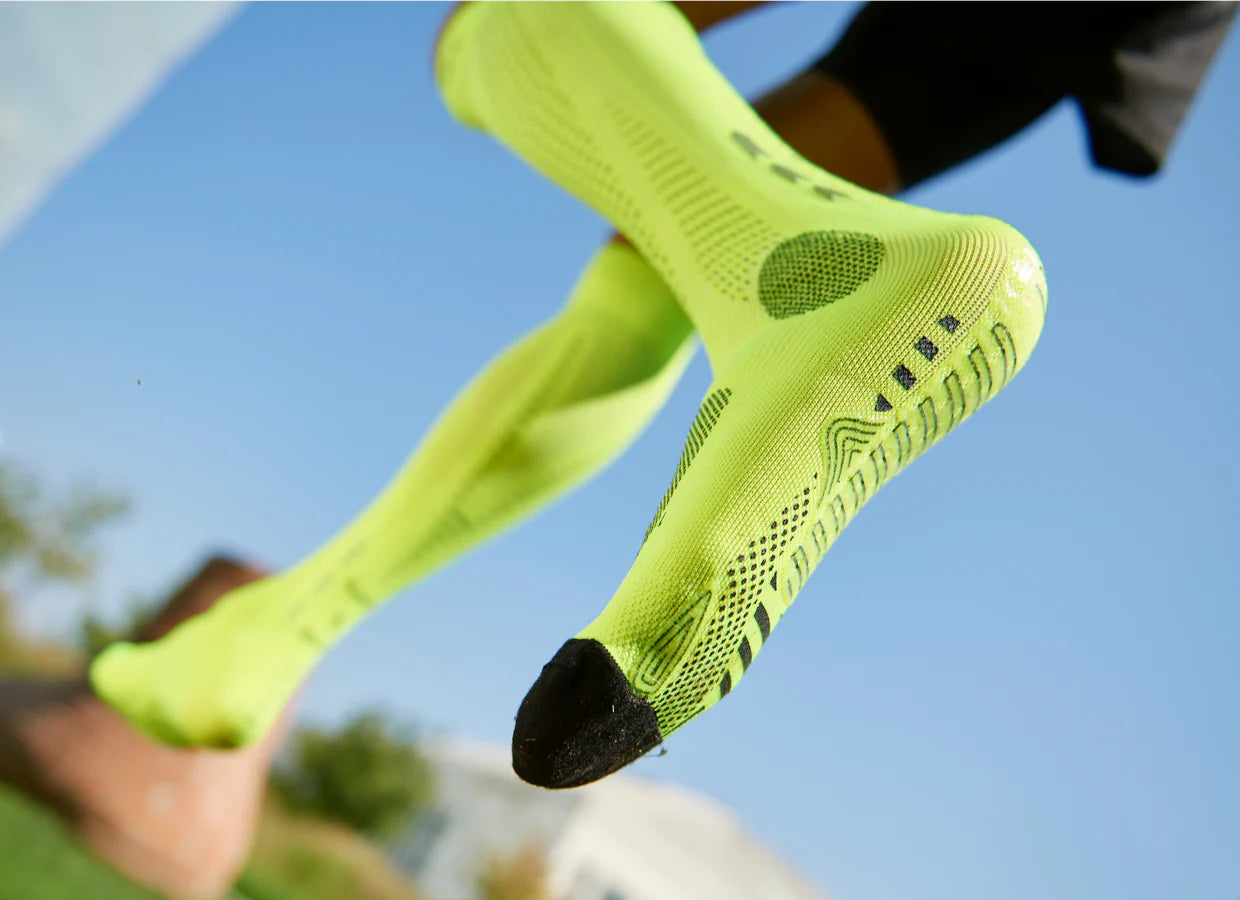
How to Choose the Best Ankle Support for Sport: Brace, Sleeve or Biomechanical Anklet?
The best ankle support for sport is the one that matches the movement demands of your sport, the level of support you need and whether you want rigid restriction or flexible compression.
For athletes who want to keep moving freely, a biomechanical anklet like the Floky Ankle Support Anklet supports the ankle with targeted compression and silicone applications, without the bulk of a traditional brace.
Many athletes choose ankle support by habit, reaching for whatever they wore last season.
This guide explains what ankle support is designed to do, how braces, sleeves and biomechanical anklets differ and how to choose the right option for your sport.
What Ankle Support Is Designed to Do
Every time you run, pivot or land, your ankle absorbs the load, controls direction and steadies the foot on the ground. Ankle support provides external structure or compression around the joint, making it feel more stable and secure under those demands.
However, it helps to be clear about expectations. Ankle support is a piece of sports equipment, not a treatment, and it does not make an injured ankle safe to play on. It works best alongside a proper warm-up, sensible training load and adequate rest.
Ankle Brace vs Ankle Sleeve vs Biomechanical Anklet
Most athletes in Australia comparing ankle support end up choosing between three styles, with each taking a different approach to structure and movement.
Rigid or Lace-Up Brace
-
Structure: Firm panels, straps or laces
-
Movement: Restricts range of motion
-
Comfort: Can feel bulky inside a shoe
-
Best suited for: Athletes who want firm restriction, often on professional advice
Elastic ankle sleeve
-
Structure: Stretch knit with no defined structure
-
Movement: Full movement with general compression
-
Comfort: Light and easy to wear
-
Best suited for: Light support and warmth during everyday training
Biomechanical Anklet
-
Structure: Compression knit with silicone applications around the ankle
-
Movement: Allows movement while supporting the joint
-
Comfort: Low profile and worn under a sock
-
Best suited for: Flexible support in fast, changeable sports
An ankle brace vs ankle sleeve decision usually comes down to restriction versus freedom. A brace limits movement, a basic sleeve offers compression without direction and a biomechanical anklet sits between the two.
What Runners, Racquet-Sport Players and Team-Sport Athletes Need
Runners. Running places thousands of repeated loads through the ankle in a single session, often on uneven ground. Runners should prioritise a low-profile design that sits comfortably in the shoe over distance. They can explore compatible gear in Floky’s running collection.
Racquet-sport players. Split steps, sudden stops and side-to-side shuffles put a great deal of pressure on the outer ankle. Racquet-sport players should look for support that follows lateral movement without slowing their footwork. Floky’s tennis, Pickleball and Padel collection is built around those demands.
Team-sport athletes. Football, netball and rugby combine cutting, landing and contact. Athletes in these sports want ankle protection that stays secure through a full match and does not add unnecessary bulk.
How Biomechanical Applications Differ From Standard Elastic Compression
A standard elastic sleeve applies a fairly even squeeze around the joint. It can be comfortable, but it is not directional. Here is where a biomechanical anklet takes the next step.
Three features set the Floky design apart:
-
Targeted silicone applications: Silicone bands are positioned in specific zones around the ankle, so they concentrate support where the joint moves rather than spread it evenly.
-
Wrap-around structure: The design creates a taping-style effect but is quicker to apply and easier to wear than strapping tape.
-
Low-profile compression knit: The anklet is designed to sit under your sock and inside your usual sports shoe, which keeps it practical for training and match play.
This combination is what separates ankle compression support built around movement from one that simply squeezes.
How to Choose the Right Size and Recognise a Poor Fit
Fit decides whether any ankle support gets used. The Ankle Support Anklet is available in XS/S, M/L and L/XL and is left- and right-specific. Make sure you choose the correct side and the correct size. The size guide on the product page is the best place to start, and prices are per anklet.
A good fit feels snug, stays in position through movement and lets your shoe close comfortably over the sock without being tight.
Take the anklet off and reassess the size if you notice any of the following:
-
Numbness, tingling or pins and needles
-
Cold or discoloured toes
-
Marks on the skin that linger after removal
-
Bunching, folding or shifting during activity
When to Stop Self-Managing and Seek Assessment
Ankle support is a tool for everyday sport, not a substitute for a proper assessment. Speak to a GP, physiotherapist or sports doctor when:
-
Pain, swelling or bruising is ongoing or getting worse
-
The ankle feels as though it gives way
-
You cannot comfortably take weight through it
-
You have rolled the same ankle more than once
Wearing support should never be the reason you play on through an injury. A professional can identify the specific cause of the problem and build a plan around it.
The Floky Ankle Setup
The best ankle support for sport is the one that suits your movement and fits properly.
The Ankle Support Anklet is the starting point for most athletes, worn under a sock in your usual sports shoes.
Who it suits:
-
Runners who want low-profile support in the shoe
-
Racquet-sport players managing repeated lateral movement
-
Team-sport athletes who want flexible support through cutting and landing
Recommended pairing for court sports: the S-MASH 3D Sock, designed for stability and support in your shoe through quick changes of direction.
Shop Floky Ankle Support in Australia
Floky compression socks are available at floky.com.au.
-
Free shipping on orders over $140
-
Afterpay available
-
48 to 72-hour dispatch from Rydalmere, NSW
-
4.6 out of 5 stars across more than 1,600 Australian reviews
Compression Socks for Running: How Fit, Length and Biomechanical Support Differ
Choosing the best compression socks for running should be based on three things: fit, coverage, intended use and length.
A runner doing short road sessions may want a different sock from someone training for a marathon or regularly tackling technical trails.
Length also matters. Short socks leave more of the lower leg uncovered, while medium and long designs provide progressively more coverage.
Runners should also consider how the sock is designed to support the foot and lower leg during repetitive movement.
For runners looking for sport-specific options, Floky’s running collection includes biomechanical socks designed specifically around the demands of running.
What Should You Expect From Compression Socks for Running?
Compression socks are not a substitute for suitable footwear, sensible training loads or recovery. Their main role is to provide a close, supportive fit around the foot and lower leg.
For runners, this can mean a more secure feeling around the foot and lower leg during repeated impacts, and targeted support in areas that work continuously throughout a run.
The important distinction is that not all compression socks are designed the same. Conventional compression focuses on applying pressure, while biomechanical designs can incorporate targeted zones and patterns intended to work with the body's movement.
This distinction is central to Floky's approach. Our running socks use biomechanical applications alongside compression, with features designed around the foot, Achilles area and lower leg.
If you are looking for a broader explanation of how compression socks work and what to consider when buying them, see Floky's guide to the best compression socks in Australia, which focuses on how those choices apply to running.
Short, Medium and Long Compression Running Socks Compared
Sock length is one of the easiest differences to see, but it can also affect which type makes sense for your running routine.
Short
-
Coverage: Foot and lower ankle
-
Best suited to: Shorter runs, warm conditions and runners who prefer minimal coverage
-
Main consideration: Less lower-leg coverage
Medium
-
Coverage: Foot to mid/lower calf
-
Best suited to: Everyday road running and mixed training
-
Main consideration: Balance between coverage and a lower-profile feel
Long
-
Coverage: Foot to upper calf
-
Best suited to: Longer runs, endurance training and runners wanting more lower-leg coverage
-
Main consideration: More coverage and a more substantial feel
There is no universal rule that says one length is better for every runner. The right choice depends on how much coverage you want and where you want the sock's support to be concentrated.
For example, Floky's RUN UP Medium Sock uses a conventional running-sock cut while incorporating biomechanical applications around the foot and lower leg. Meanwhile, the RUN UP Long Sock extends the coverage further up the lower leg for runners who prefer a full-length design.
Choosing Compression Socks for Different Types of Running
Your usual running sessions can help narrow down the right option.
Easy and Everyday Training
A medium-length running sock is a practical choice if you want running-specific support without the additional coverage of a long sock. The RUN UP Medium is designed around the biomechanics of running and provides support around the foot, forefoot, heel and Achilles area.
Racing and Faster Sessions
Look beyond compression if you're focused on performance. A sock should sit securely inside your running shoe without bunching, slipping or creating distracting pressure points. A biomechanical design may also appeal if you want targeted support around the areas involved in your running movement.
Long-Distance Running
Long running sessions place sustained demands on the feet and lower legs. A long sock provides more coverage and may suit runners who prefer support extending further up the calf. Floky's RUN UP Long is specifically designed for running and provides full lower-leg coverage.
Post-Run Recovery
Your needs change once the session is finished. Rather than choosing another performance-focused running sock, you may need a product specifically designed for post-training use. RE-CHARGE is Floky's biomechanical recovery sock, designed to support the foot and leg after training or competition.
Road Running vs Trail Running
Road and trail running share many requirements, but the demands on your feet can differ.
Road running involves repetitive movement on a relatively predictable surface. Fit, comfort and consistent support become particularly important when you're repeating the same stride pattern for kilometres at a time.
Trail running introduces more variation. Uneven surfaces, changes in direction, climbs and descents can place different demands on foot stability and control. A secure sock fit is crucial because unwanted movement inside the shoe can become distracting over longer sessions.
For runners who prioritise footwear stability, AXSIST offers a more stability-focused biomechanical design. Although developed specifically for football, its design addresses foot stability during running and changes of direction, so it may be worth considering for runners whose training includes substantial lateral movement.
Getting the Fit Right
Compression socks should feel supportive without becoming uncomfortable. This means getting the size right is more important than simply choosing the tightest option.
Check the manufacturer's sizing information rather than relying solely on your usual clothing size. Floky's sizing varies between product designs, with its RUN UP Long and Medium socks using different size ranges.
Here are a few ways a poor fit can show up:
-
Persistent pinching or excessive pressure
-
Numbness or tingling
-
The socks bunching around the ankle or calf
-
Excessive movement inside the shoe
-
Folds creating pressure points
-
A cuff that feels uncomfortably restrictive
If socks feel uncomfortable as soon as you put them on, increasing the distance you run in them is unlikely to solve the underlying fit problem. Try a different size or design instead.
It is also worth remembering that more compression is not automatically better. The aim is a supportive, comfortable fit that suits your intended activity.
Biomechanical Support vs Standard Compression
This is where compression running socks can differ most significantly.
Standard compression socks primarily use graduated pressure to create compression along the foot and lower leg. Biomechanical socks take a different approach by combining compression with targeted applications designed around movement and specific anatomical areas.
Floky's running range uses this biomechanical approach.
For example, RUN UP Medium incorporates targeted applications around the foot and lower leg, while RUN UP Long provides the same running-specific design with greater lower-leg coverage.
If you’re a runner, this means the decision does not have to be “compression or no compression”. You can also consider how the sock is constructed and whether its support is designed around the movements and areas relevant to your sport.
Which Running Compression Socks are Right for You?
The simplest way to narrow down the options is to start with your normal training.
-
Everyday road runner: Consider RUN UP Medium for running-specific biomechanical support in a medium-length design.
-
Long-distance or endurance runner: Consider RUN UP Long if you prefer greater lower-leg coverage.
-
Runner who prioritises stability: Consider AXSIST if stability and changes of direction are an important part of your training.
-
Runner looking for post-training support: Consider RE-CHARGE if you need a sock designed specifically for recovery after training or competition.
Ultimately, the best compression socks for running are the ones that match your fit, preferred coverage, and training demands. Length is only one part of the decision; the construction and type of support can be just as important.
Ready to compare your options? Explore Floky's Running collection to find the biomechanical running sock that best matches your distance, training style and preferred level of coverage.
Shop Floky Compression Socks in Australia
Floky ankle support is available at floky.com.au.
-
Free shipping on orders over $140
-
Afterpay available
-
48 to 72-hour dispatch from Rydalmere, NSW
-
4.6 out of 5 stars across more than 1,600 Australian reviews