Long-distance running has a way of exposing every small problem with your gear. A sock that feels slightly warm over 5 kilometres can become unbearable late in a marathon. A waistband that moves once during an easy run can chafe for hours during an ultra. Even a seam you had never noticed may suddenly make its presence known with the confidence of a race official carrying a time penalty.
This is why compression gear for long-distance running should be chosen differently from gear for a short session. The question is not simply whether a garment feels supportive when you first put it on. It must remain comfortable as your feet swell, your form changes, the temperature rises and fatigue accumulates.
Compression socks, shorts and tights can provide close-fitting coverage and targeted support, but they are not essential for every runner and they are not a shortcut to endurance. The right garment may improve comfort, reduce unwanted movement or help you feel more supported. The wrong one is simply another thing you will wish you had left in your drop bag.
This guide explains which compression gear may be worth wearing for marathons, trail races and ultramarathons, how the different options compare and how to test them properly before race day.
What does compression gear do during long-distance running?
Compression running gear applies pressure or targeted structural support to selected areas of the body. Depending on the garment, this may include the feet, calves, thighs, hamstrings, glutes, knees or the full lower body.
Some runners value the firm, contained feeling created by compression. Close-fitting garments may reduce the sensation of soft-tissue movement, provide additional proprioceptive feedback and remove the loose fabric that can bunch or flap over many hours. Technical garments may also include targeted support zones, anti-slip elements, breathable panels or different levels of compression across particular areas.
Those practical details can matter during long events. However, compression gear should be viewed as supportive equipment rather than a performance guarantee. A sock cannot compensate for poor pacing, inadequate fuelling or insufficient training. Tights cannot turn an underprepared runner into an ultramarathoner, although they may make the long walk back to the car look slightly more professional.
Does compression gear improve endurance performance?
The research does not show that simply wearing compression will reliably make runners faster. A 2025 systematic review and meta-analysis found that wearing compression socks during running did not meaningfully improve physiological measures, running performance, perceived exertion or muscle soreness compared with ordinary socks. An updated review of compression garments and running performance similarly found no clear improvement in race time, time to exhaustion, running economy or other performance outcomes.
That does not mean compression gear has no value. Research trials look for consistent group-level effects, while an individual runner may still prefer the comfort, warmth, fit or supported feeling of a particular garment. A product can be worthwhile because it solves a practical problem without needing to take minutes off a finishing time.
Evidence for post-exercise recovery is also mixed. A 2026 systematic review focused on endurance athletes found that results for soreness tended to favour compression, but the evidence was very uncertain and did not establish a reliable improvement in later endurance performance. In other words, compression may help some athletes feel better after a demanding event, but it should remain an optional addition to sleep, nutrition, hydration and appropriate recovery time.
For long-distance runners, the most realistic reasons to wear compression are therefore:
-
the garment feels comfortable and supportive over your intended distance;
-
it reduces movement, bunching or friction compared with your alternative gear;
-
its targeted construction supports an area you want covered;
-
it works well with your shoes, shorts and other layers; and
-
it gives you a setup you have tested and trust.
Which compression gear is worth considering for long distances?
The best option depends on where you want support and the conditions in which you will run.
| Your main priority | Compression option | Floky product to consider |
|---|---|---|
| Foot, heel and Achilles support with moderate lower-leg coverage | Mid-length running sock | RUN UP Medium |
| Foot-to-calf support and full lower-leg coverage | Long running compression sock | RUN UP Long |
| Hip, glute, hamstring and thigh support | Compression shorts | ACTIVATOR Shorts |
| Full-leg coverage with targeted knee support | Compression tights | HYPER Man Leggings or HYPER Woman Leggings |
| Post-race lower-leg compression | Recovery sock | RE-CHARGE Sock |
You do not need to wear every layer together. In most cases, the better approach is to identify a real need and choose the least complicated setup that addresses it.
Compression socks for long-distance running
Your socks sit directly between your feet, shoes and the ground, making them one of the most consequential pieces of long-distance running gear. The ideal sock should stay in position, manage moisture, work with the available space inside the shoe and remain comfortable as the foot expands during a long event.
Compression socks for long-distance running add a supported fit through part or all of the lower leg. Unlike a standalone calf sleeve, a full sock can also include technical features through the foot, heel and Achilles area.
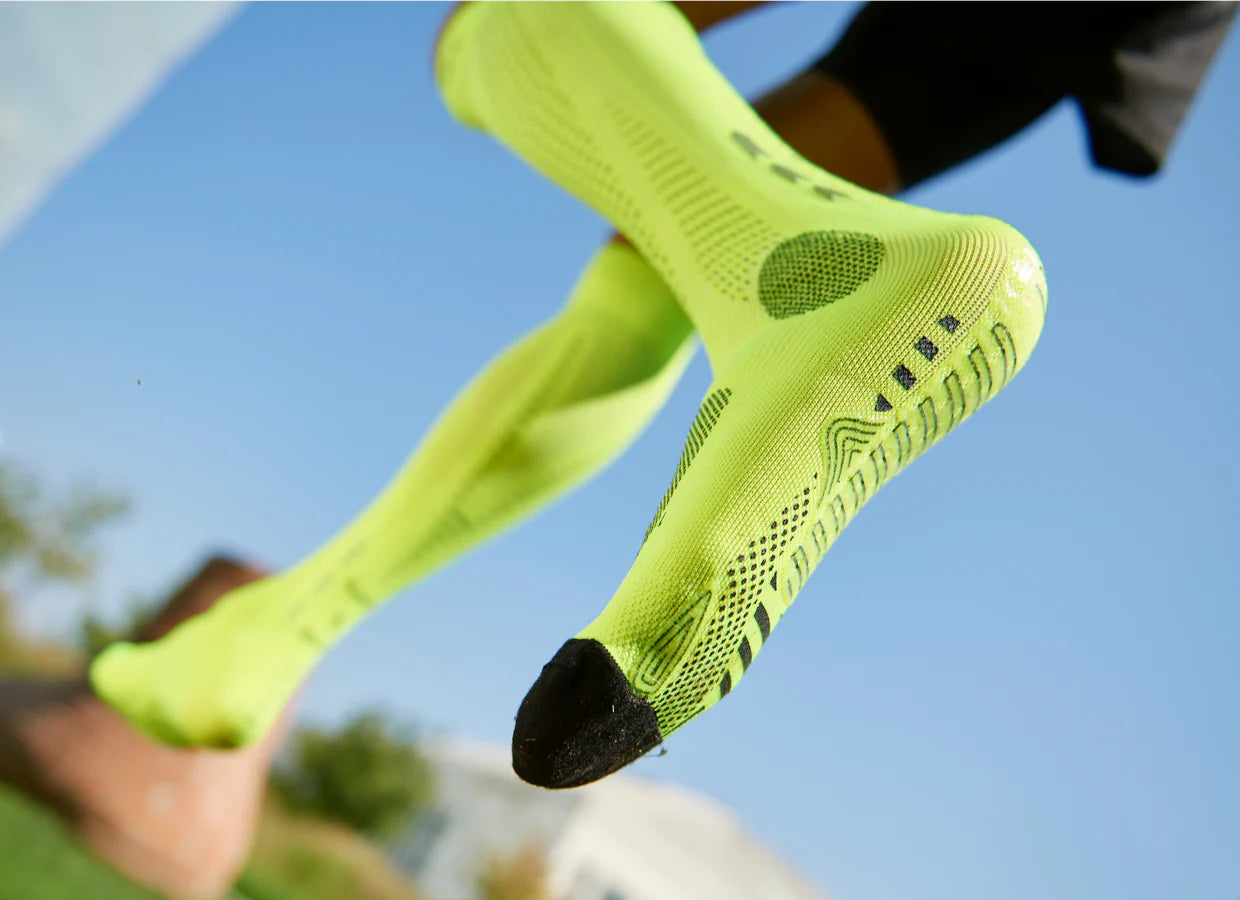
The Floky RUN UP Medium is a mid-length biomechanical running sock designed with targeted applications around the foot, forefoot, heel, Achilles tendon and lower leg. It includes an external non-slip print intended to improve contact with the shoe, targeted compression through the plantar area, breathable sections and external applications designed to minimise internal rubbing points.
This may suit marathon and ultra runners who want a technical running sock without full over-the-calf coverage. The shorter cut can also be easier to tolerate in warmer conditions, although individual heat tolerance will always vary.
The RUN UP Long extends the same general concept over the calf. It combines in-shoe features with targeted coverage around the heel, Achilles tendon, tibial and peroneal area and calf. It is the more relevant option for runners specifically searching for compression socks for ultra running or broader lower-leg support.
Choose RUN UP Long when calf coverage is a priority. Choose RUN UP Medium when you want support concentrated around the foot, heel and Achilles area with less fabric on the lower leg. Neither choice should be made solely because one looks more “ultra”. Comfort over distance remains the deciding factor.
Compression shorts for long-distance running
Compression shorts can be useful when you want close-fitting support through the hips, glutes, hamstrings and thighs without covering the knees and calves. They can also reduce loose fabric between the legs, although chafing still depends on seam placement, fit, moisture and the individual runner.
The Floky ACTIVATOR Shorts use graduated compression and screen-printed biomechanical applications across the upper legs, hips and glutes. Floky designed these applications to help manage vibration and provide muscle stability, while anti-slip sections at the waist and legs are intended to help the shorts remain in position.
For long-distance runners, the practical appeal is targeted upper-leg support without the additional warmth of full-length tights. ACTIVATOR may suit runners who prefer a compressed feeling around the hamstrings and thighs, or who want a fitted base layer beneath looser race shorts.
Before using compression shorts for long-distance running, test where the leg openings sit and whether the waistband remains comfortable while climbing, descending, hiking and carrying a hydration vest. An edge that stays comfortable on flat roads may behave differently after several hours of steep terrain.
Compression tights for marathon and ultra running
Full-length tights provide the broadest coverage. They can combine upper-leg compression with support around the knees and lower legs, while also adding warmth and protection from wind, vegetation or cool starts.
HYPER Man Leggings and HYPER Woman Leggings use graduated compression, targeted applications and bioceramic fabric. Floky positions both designs around muscle stability, knee support, glute support and post-activity recovery, with separate constructions for men and women.
HYPER Leggings may be the more logical option for a cool-weather marathon, an overnight ultra or a runner who prefers continuous full-leg support. They may be less practical in high heat, particularly when combined with long compression socks. More coverage is not automatically more useful; sometimes it is just more fabric collecting the evidence of every aid station.
If wearing full-length compression tights, test them with your race socks to ensure the layers do not create excessive pressure or bunching around the calf or ankle. Also check storage. If your usual shorts carry gels, a phone or mandatory equipment, confirm that your tights or outer layer can carry the same load without bouncing.
Recovery socks after a marathon or ultra
Compression worn after running serves a different purpose from compression worn during the event. Race gear must work under heat, impact and movement. Recovery gear only needs to remain comfortable while you cool down, travel, eat and begin recovering.
The Floky RE-CHARGE Sock is designed specifically for post-training or post-competition use. It provides full lower-leg coverage with compression through the foot and leg, making it the most recovery-focused product in the Floky running range.
The research does not support promising dramatically faster biological recovery. The latest endurance-specific review found that possible reductions in perceived soreness remain uncertain. A recovery sock may still be worth using if you personally find the compression comfortable after long efforts, particularly when you will spend time sitting or travelling after the race.
Change out of wet or dirty race socks first. Put recovery socks on only if your feet and legs have been checked for blisters, broken skin, unusual swelling or injury, and remove them if you experience pain, numbness, tingling, unusual coldness or colour changes.
Marathon vs ultramarathon: does the distance change what you should wear?
The same principles apply to both, but ultramarathons amplify the consequences of small fit problems and expose gear to a wider range of conditions.
For a road marathon, you may be running at a relatively consistent pace in predictable conditions. A tested pair of RUN UP Medium or Long socks may be the only compression gear you need. ACTIVATOR Shorts can add upper-leg support if you already know they remain comfortable at race pace.
During an ultra, you may alternate between running, hiking, climbing and descending. Temperatures can change substantially, feet can swell, and clothing may be worn for many more hours. Long socks can add calf coverage and some protection from trail debris, while shorts may be easier to manage in heat. Full tights can make sense for cold, exposed or overnight sections, but only if you have tested them in similar conditions.
Ultra runners should also consider whether compression gear is easy to change. A sock that takes patience to position correctly at home may become difficult to replace when your hands are cold, your feet are swollen and your decision-making has been outsourced to a slightly crushed banana.
Are long compression socks better for trail running?
Long socks can provide more coverage from dust, low vegetation and minor contact with the trail environment. They may also help some runners feel more supported around the calves during prolonged climbing and descending.
However, compression socks are not gaiters. They will not reliably stop sand, stones or debris from entering the shoe, and they do not provide protection against every scratch, bite or environmental hazard. Technical trail footwear, gaiters where appropriate and terrain-specific preparation remain separate considerations.
For warm trail races, compare the calf coverage of RUN UP Long with the lower cut of RUN UP Medium. The long version provides more compression and coverage; the medium version may feel cooler and easier to pair with gaiters. The best choice is whichever survives your longest training simulation without creating heat, pressure or rubbing problems.
How should long-distance compression gear fit?
Compression should feel firm and supportive, not painful or restrictive. The garment should lie flat against the body without rolling, folding or creating a sharp band. Socks should not crush the toes, and tights or shorts should not restrict normal breathing, hip movement or stride.
Do not deliberately choose a smaller size to create more compression. Targeted zones only work as intended when they sit in the correct position, and undersizing can create unwanted pressure. Follow the measurements in the product-specific size guide rather than assuming your usual casual-clothing size will translate directly.
Correct fit at the start is only the first test. Long-distance runners also need to consider:
-
Foot swelling: shoes and socks can feel tighter after several hours.
-
Heat: added coverage may become less tolerable as conditions warm.
-
Moisture: sweat, creek crossings and rain can change friction.
-
Layer overlap: socks, tights and sleeves can create tight bands where they meet.
-
Aid-station access: clothing should not make toilet stops, blister care or layer changes unnecessarily difficult.
Remove compression gear if it causes numbness, pins and needles, discolouration, unusual coldness, escalating pain or loss of normal movement.
How to test compression gear before race day
Do not judge long-distance gear from one short run. Build the test gradually so you can identify problems before they become expensive entries in your race report.
Start with an easy run of 30 to 60 minutes. Check the fit inside your shoes, whether the garment moves and whether any seam or edge becomes noticeable. Next, wear it for a longer run that includes the surfaces and elevation expected on race day. Use the same shoes, anti-chafe product, underwear, hydration vest and outer layers you plan to race in.
Your final test should reproduce the likely conditions as closely as practical. For an ultra, include several hours on feet, sustained climbs and descents, eating, carrying mandatory gear and some walking. If your event may be hot, cold or wet, test the garment in those conditions rather than assuming it will behave the same way.
After each run, inspect your skin and feet. Look for pressure marks that remain unusually long, new hot spots, chafing or blisters. Record whether the garment became hotter, tighter or more annoying as the run progressed. “I stopped noticing it” is usually a better result than “it felt incredibly compressive.”
A simple compression setup for different runners
There is no universal endurance outfit, but these combinations provide a sensible starting point.
For foot and Achilles-focused support
Wear RUN UP Medium during training and racing. It provides targeted running-specific construction through the foot, heel and Achilles area without full calf coverage. This can suit runners who want a technical sock but prefer a lighter-feeling lower leg.
For calf and full lower-leg support
Choose RUN UP Long. Its over-the-calf design is the closest Floky option for runners considering calf sleeves or long compression socks for ultra running, while still including integrated support through the foot and heel.
For upper-leg support in warmer conditions
Pair RUN UP Medium or Long with ACTIVATOR Shorts, provided both garments have been tested together. This combination separates foot and lower-leg support from compression through the hips, glutes and thighs without adding full-length leg coverage.
For cool conditions and broad leg coverage
Consider HYPER Leggings with your preferred RUN UP sock. Check carefully for overlapping pressure around the lower leg and make sure the combined setup is not too warm for the event.
For after the finish
Change into clean, dry clothing and consider RE-CHARGE Socks if post-event lower-leg compression feels comfortable for you. Nutrition, rehydration, sleep and appropriate rest remain the priorities.
When should you avoid compression gear?
Do not use compression to disguise an injury or justify continuing through worsening pain. Persistent focal pain, significant swelling, loss of strength, altered gait or suspected bone stress requires appropriate assessment.
Sports compression is also not a substitute for prescribed medical compression. Anyone with peripheral vascular disease, diabetes-related circulation problems, unexplained swelling, reduced sensation or a history of blood clots should seek medical advice before using compression garments. A health professional can advise whether compression is appropriate and what pressure is required.
The verdict: what compression gear is worth wearing for long-distance running?
Compression gear is worth considering when it solves a specific comfort or support problem and has proved itself during training. It is not worth wearing simply because endurance runners are expected to look as though they are being gently vacuum sealed.
RUN UP Medium is the versatile choice for runners prioritising the foot, heel and Achilles area with moderate lower-leg coverage. RUN UP Long adds full calf coverage for runners who prefer a more supported feeling throughout the lower leg. ACTIVATOR Shorts extend support to the hips, glutes, hamstrings and thighs, while HYPER Leggings offer a full-leg option for cooler conditions or runners wanting knee coverage. RE-CHARGE is the recovery-specific choice after training or competition.
Whichever option you choose, use the correct size, introduce it gradually and test it over the distance, terrain and conditions you expect on race day. The best compression gear is not the tightest or most technical-looking. It is the gear you can wear for hours without needing to think about it.
Frequently asked questions
Are compression socks good for long-distance running?
Compression socks can be suitable for long-distance running when they fit correctly, work with your shoes and remain comfortable as your feet and lower legs warm up or swell. They may provide a supported feeling and additional lower-leg coverage, but research does not show a consistent improvement in running performance.
Should I wear compression socks during an ultramarathon?
You can wear compression socks during an ultramarathon if you have tested them on comparable long runs. Consider heat, moisture, foot swelling and how easily the socks can be removed or changed. RUN UP Long offers full calf coverage, while RUN UP Medium provides less lower-leg coverage.
Are compression shorts good for long-distance running?
Compression shorts can provide close-fitting coverage and support around the hips, glutes, hamstrings and thighs. Their value depends on fit and comfort. Test the waistband, leg openings and seams during a long run before using them in a race.
Are compression tights better than shorts for an ultra?
Tights provide more coverage and warmth, which may suit cold, exposed or overnight events. Shorts may be easier to tolerate in heat and simpler for layer changes. Neither is universally better; choose according to conditions and your tested preference.
Can I wear compression shorts and compression socks together?
Yes, if both garments fit correctly and do not create uncomfortable overlap or excessive pressure. Test the combination during training and remove either garment if you develop numbness, tingling, colour changes or pain.
Do compression socks prevent fatigue during long runs?
Some runners report that compression makes their legs feel more supported or reduces perceived movement. However, compression socks have not consistently been shown to reduce fatigue or improve endurance performance. Pacing, training, fuelling, hydration and recovery have much larger roles.
Should I wear recovery socks after an ultramarathon?
Recovery socks are optional. Some runners find them comfortable after long events, but current evidence for reducing soreness or improving later endurance performance is uncertain. Check your feet and legs for injury first and prioritise nutrition, hydration, sleep and adequate recovery time.
How long before a race should I test compression gear?
Begin several weeks before race day so you have time to complete a short test, a normal long run and at least one event-specific simulation. Do not introduce new compression gear at race registration or the night before the event.
This article provides general information only and is not a substitute for individual medical advice. Seek professional assessment for persistent or worsening pain, significant swelling, altered sensation, suspected injury or concerns about circulation.