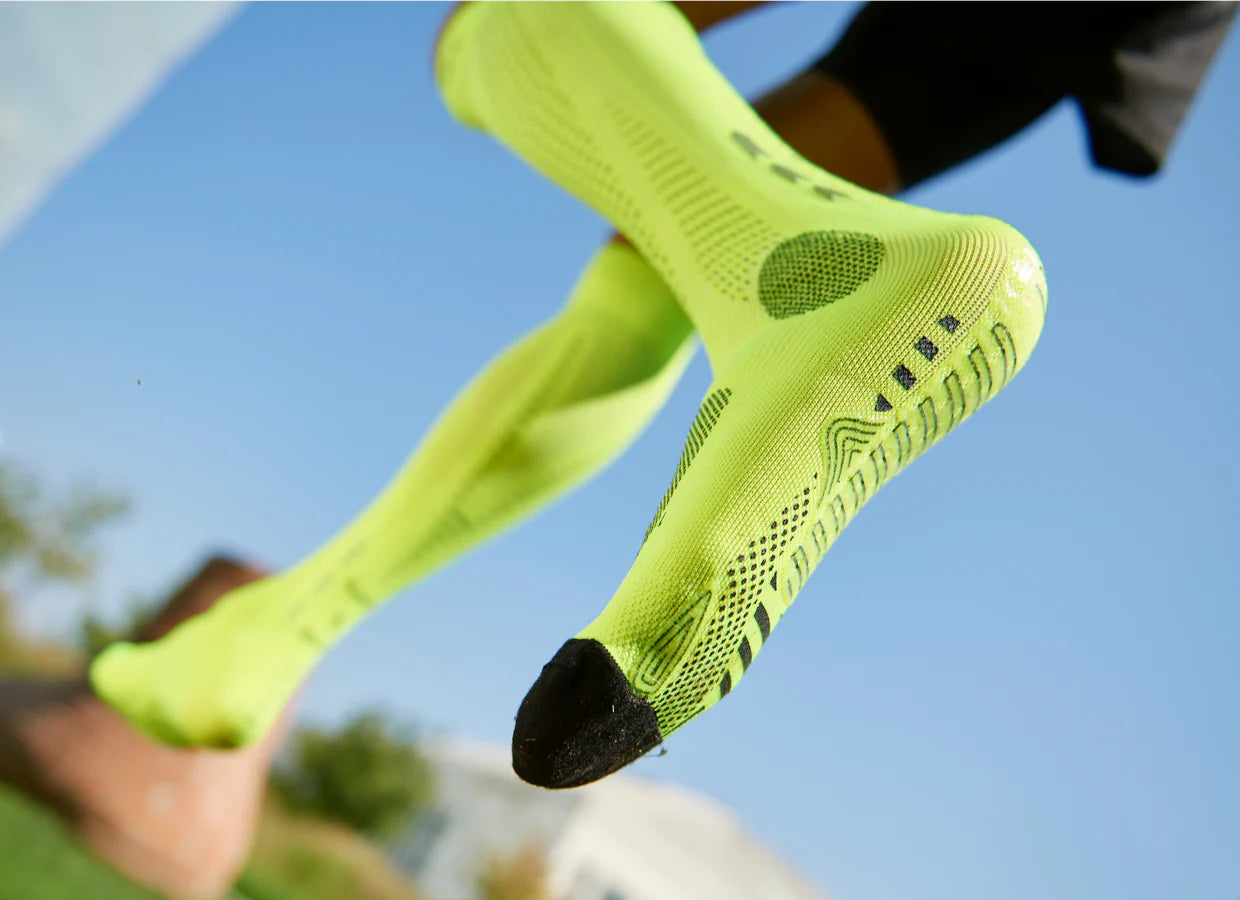
If you are looking for more support through the lower leg, you will usually come across two options: calf compression sleeves and full compression socks. At first glance, the difference seems simple. One covers the calf, while the other also covers the foot. Once you start running in them, however, that extra coverage can change how the garment feels and what it supports.
Calf sleeves can be a practical choice when you only want compression around the lower leg or prefer to wear your usual running socks. Compression socks provide a more integrated option, combining calf coverage with support through the foot, heel and ankle. Neither is automatically better for every runner.
The right choice depends on why you want compression, where you want support and what feels comfortable across the distances you run. This guide compares compression socks vs sleeves for running so you can choose the option that makes sense for your training rather than simply picking whichever looks more serious at the start line.
What are calf compression sleeves for running?
Calf compression sleeves are close-fitting tubes worn between the ankle and knee. They apply pressure around the calf while leaving the foot exposed, allowing you to pair them with almost any running sock.
Many runners use compression calf sleeves for running because they like the feeling of support around the lower leg. The sleeve may also help limit some of the soft-tissue movement that occurs as the foot repeatedly contacts the ground. For others, the main appeal is practical: they can continue wearing a familiar sock while adding compression only where they want it.
Because a sleeve stops near the ankle, it does not provide compression or structural support through the foot, arch or heel. That is not necessarily a problem if the calf is your only priority, but it is the most important limitation to understand when comparing sleeves with socks.
What are compression socks for running?
Running compression socks cover the foot and continue up the lower leg. Depending on their length and design, they may finish around the lower calf or extend to just below the knee.
A basic compression sock may primarily apply pressure. A more technical running sock can also include targeted features intended to improve comfort, limit movement inside the shoe and support specific areas exposed to repetitive running loads.
For example, the Floky RUN UP Long is an over-the-calf biomechanical running sock rather than a simple elastic tube with a foot attached. It combines calf compression with targeted applications around the plantar area, fifth metatarsal, tibial and peroneal region, heel and Achilles tendon. It also uses an external anti-slip print to help reduce movement inside the shoe and breathable sections to manage perspiration.
That broader construction is the main reason a compression sock may suit runners who want support to begin at the point where the foot meets the shoe—not only above the ankle.
Compression socks vs sleeves for running: the main differences
Both products cover the calf, but their role during a run is not identical.
| Feature | Calf compression sleeve | Full compression sock |
|---|---|---|
| Coverage | Ankle to below the knee | Foot to below the knee |
| Primary focus | Calf and lower-leg compression | Foot, ankle and lower-leg coverage |
| Running sock required | Yes | No separate sock required |
| Support inside the shoe | Depends on the separate sock | Can be built into the garment |
| Heel and Achilles coverage | Limited or none | Yes, depending on design |
| Foot and arch coverage | None | Yes, depending on design |
| Flexibility | Works with your preferred socks | One integrated piece of running gear |
| Best suited to | Runners wanting calf-only compression | Runners wanting connected support from foot to calf |
The distinction matters because the calf does not work in isolation. Every stride involves the foot, ankle, Achilles tendon and calf working together to absorb force and help move the body forwards. A sleeve addresses one part of that chain. A well-designed running sock can cover more of it.
Why do runners wear compression on their calves?
Running creates repeated loading through the lower legs. As distance, speed or hills increase, the calves can feel heavy or fatigued, particularly when training volume has recently changed.
Some runners wear compression because it creates a firm, supported feeling around the calf. It may also increase awareness of the area and reduce the sensation of muscle movement during each foot strike. Other runners simply find that compression gear feels comfortable during long sessions or afterwards.
It is important to keep the likely benefits in perspective. Compression gear is not a shortcut to faster race times, nor can it guarantee that a runner will avoid calf, shin or Achilles injuries. Research on compression clothing and running has produced mixed results. A 2025 systematic review found that compression socks worn during running did not meaningfully improve physiological measures, performance, perceived exertion or muscle soreness, while an earlier review of compression clothing in runners identified some possible benefits for perceived exertion, time to exhaustion and post-run soreness.
In practical terms, compression is best viewed as supportive equipment. If it helps you feel more comfortable or supported, that can still be useful. It should sit alongside sensible training progression, calf strength, suitable footwear, sleep and recovery—not attempt to replace them.
When might calf compression sleeves be the better choice?
Calf sleeves make sense when your priority begins and ends with the lower leg. They allow you to keep wearing a running sock you already trust, which can be helpful if you are particular about thickness, toe construction or how a sock fits inside your shoes.
You may prefer a calf sleeve if:
-
you only want compression around the calf;
-
you already have running socks that reliably manage moisture and friction;
-
you want to change socks without changing your calf compression;
-
you prefer less fabric covering the foot; or
-
you want to wear the sleeve before or after a run without keeping a full sock on.
Sleeves can also be easier to combine with different footwear because the material inside the shoe does not change. If your running shoes already fit closely, changing to a thicker compression sock may affect how much room you have around the toes or midfoot.
The trade-off is that any support, grip or moisture management below the ankle will come from your separate sock. The sleeve cannot help with movement between the foot, sock and shoe, and it does not extend across the heel or plantar arch.
When might compression socks be the better choice?
Compression socks are often the more logical option when you want lower-leg support to work as part of a complete running sock.
They may suit runners looking for:
-
continuous coverage from the foot to the calf;
-
support around the heel or Achilles tendon;
-
targeted compression through the plantar area or midfoot;
-
fewer separate layers and garment edges around the ankle;
-
grip features intended to reduce movement inside the shoe; or
-
one piece of gear designed specifically for running.
This is where RUN UP Long differs from a standard calf sleeve. Its Tape System extends around the calf, heel and Achilles area, while targeted applications across the foot are designed to support stability and manage movement. The sock also includes tibial and peroneal applications intended to reduce lower-leg vibration, plus external construction designed to minimise internal rubbing points.
For a runner searching for calf compression sleeves but also thinking about foot stability, Achilles support or in-shoe comfort, a full biomechanical sock may offer the more complete answer.
Does the gap at the ankle matter?
With a calf sleeve, the lower edge usually sits near the ankle while the running sock comes up underneath or meets it. If both garments fit well, this may cause no issue at all. If they overlap, bunch or create a tight band, however, the combination can become uncomfortable over longer distances.
A full compression sock removes this junction. Pressure and fabric continue through the ankle into the foot, which can feel smoother for runners who dislike overlapping layers. It also means there is no exposed strip of skin between a short sock and the sleeve.
That does not make full socks universally more comfortable. Some runners dislike compression across the foot, while others find an integrated sock feels more secure. As with shoes, the best design is the one that fits your body and remains comfortable after the novelty of standing in front of the mirror has worn off.
Are compression sleeves or socks better for shin discomfort?
Both options cover at least part of the lower leg, but neither should be treated as a cure for shin pain or shin splints.
A calf sleeve may provide a supported feeling around the muscles of the lower leg. A longer running sock can cover the calf and tibial area while also addressing the foot and heel. RUN UP Long includes a mechanical elastic application across the tibial and peroneal region designed to help stabilise the area and reduce vibration.
The broader issue is that shin discomfort can have several causes, including a rapid increase in training load, changes in running surface, footwear, muscular capacity or bone stress. Persistent, worsening or highly localised pain should be assessed by an appropriate health professional. Compression should not be used to hide pain and continue increasing mileage.
What about Achilles and heel support?
This is one of the clearest differences between a sleeve and a full sock. Most calf sleeves finish above the heel, so they do not directly cover the Achilles tendon or the point where the heel sits inside the shoe.
RUN UP Long uses Floky’s Tape System around the Achilles area and additional thickness at the heel. It is designed to provide a stabilising, vibration-dampening effect while helping protect the heel during ground contact. The RUN UP Medium uses similar biomechanical features around the foot, heel and Achilles but finishes lower on the calf.
No sock can make an injured Achilles safe to run on. New pain, swelling, weakness or a sudden loss of function warrants professional assessment. For runners who are already able to train and simply want a sock with targeted construction around this area, however, coverage matters—and a calf-only sleeve cannot provide it.
Is RUN UP Long a calf compression sleeve?
Technically, no. RUN UP Long is a full-length biomechanical running sock. It is, however, Floky’s closest option for a runner searching for calf compression because it extends over the calf and includes targeted lower-leg compression.
The key difference is that it does more than cover the calf. RUN UP Long is designed as a filter between the foot, shoe and ground, with features intended to support:
-
calf compression and lower-leg coverage;
-
the plantar area and side of the foot;
-
the heel and Achilles tendon;
-
the tibial and peroneal region;
-
stability inside the shoe;
-
breathability and perspiration management; and
-
visibility through reflective arrow details.
If you want the freedom to combine a sleeve with your existing socks, a standalone calf sleeve may be preferable. If you want calf coverage integrated into a running-specific sock, RUN UP Long is the better match within the Floky range.
RUN UP Long vs RUN UP Medium: which should you choose?
Both RUN UP styles are designed specifically for running and use targeted applications around the foot, heel and Achilles area. The most important difference is the amount of lower-leg coverage.
Choose RUN UP Long if calf compression is a priority. Its over-the-calf design provides broader coverage and incorporates compression through the calf, making it the closer alternative to a calf sleeve.
Choose RUN UP Medium if you want biomechanical support through the foot, heel and Achilles without full calf coverage. Its lower cut may appeal in warmer weather or to runners who prefer less compression around the lower leg.
Your choice should be based on the support you want rather than an assumption that more compression is always better. The correct fit should feel firm and secure without pain, numbness or restriction.
How should running compression gear fit?
Whether you choose sleeves or socks, sizing is crucial. Compression should feel close and supportive, but it should not cause tingling, numbness, unusual coldness, skin discolouration or pain. The fabric should sit flat without rolling, bunching or creating a sharp band around the ankle or below the knee.
Do not deliberately size down to create stronger compression. This can alter where the intended support zones sit and may make the garment unnecessarily restrictive. Use the specific manufacturer’s size guide because sizing methods vary between products. RUN UP Long, for example, uses both shoe size and height in its men’s and women’s size charts.
Test new compression gear on a shorter training run before wearing it for a long run or race. Race day already has enough variables without discovering at kilometre 28 that your socks have developed a personality.
Can you wear calf sleeves or compression socks for every run?
Many runners can wear correctly fitted sports compression gear regularly, but you do not have to use it for every session. Some reserve full-length socks or sleeves for long runs, races, hill sessions or days when they prefer additional lower-leg coverage. Others like the consistent feel and use them more often.
Pay attention to comfort, temperature and how the garment works with your shoes. Remove it if you notice numbness, pins and needles, colour changes, unusual coldness or increasing discomfort.
People with diabetes-related circulation concerns, vascular disease, unexplained swelling or a history of blood clots should seek medical advice before using compression garments. Sports compression is not automatically equivalent to prescribed medical-grade compression.
The verdict: compression socks or calf sleeves for running?
Choose a calf compression sleeve when you want targeted calf coverage and the flexibility to keep using your preferred running socks. Choose a compression sock when you want a single garment that connects calf compression with support through the foot, heel and ankle.
For runners who only want a firm feeling around the calf, sleeves can be simple and effective. For runners who think of the lower leg as a connected system—and want support to extend from inside the shoe to below the knee—a technical full-length sock offers more comprehensive coverage.
Floky’s RUN UP Long biomechanical running sock is designed for that second group. It combines calf compression with targeted applications around the plantar area, fifth metatarsal, tibial and peroneal region, heel and Achilles tendon. If you want the same running-specific foot and Achilles features with less calf coverage, consider RUN UP Medium.
Ultimately, the best choice is the one that fits correctly, stays comfortable at your usual distance and supports the areas that matter to you.
Frequently asked questions
Are compression socks better than calf sleeves for running?
Compression socks are not automatically better, but they provide more complete coverage. They may be preferable if you want support through the foot, heel, ankle and calf. Sleeves may suit you better if you only want calf compression and prefer to use your existing running socks.
Can I wear calf compression sleeves with running socks?
Yes. Calf sleeves are designed to be worn with separate socks. Make sure the garments do not bunch or overlap in a way that creates an uncomfortable band near the ankle.
Do calf compression sleeves prevent running injuries?
No compression garment can guarantee injury prevention. Sleeves may help some runners feel more supported, but injury risk is also influenced by training load, strength, previous injury, footwear, sleep and recovery.
Are compression socks good for long-distance running?
They can be, provided they fit correctly and remain comfortable. Test them during training before using them in a race, paying particular attention to shoe fit, heat, moisture and any pressure around the toes or calf.
Which Floky sock provides the most calf coverage?
RUN UP Long provides full over-the-calf coverage and is the closest Floky alternative to a calf compression sleeve. RUN UP Medium finishes lower and focuses more on biomechanical support through the foot, heel and Achilles area.
This article provides general information only and is not a substitute for individual medical advice. Seek assessment for persistent or worsening pain, significant swelling, altered sensation or an acute running injury.