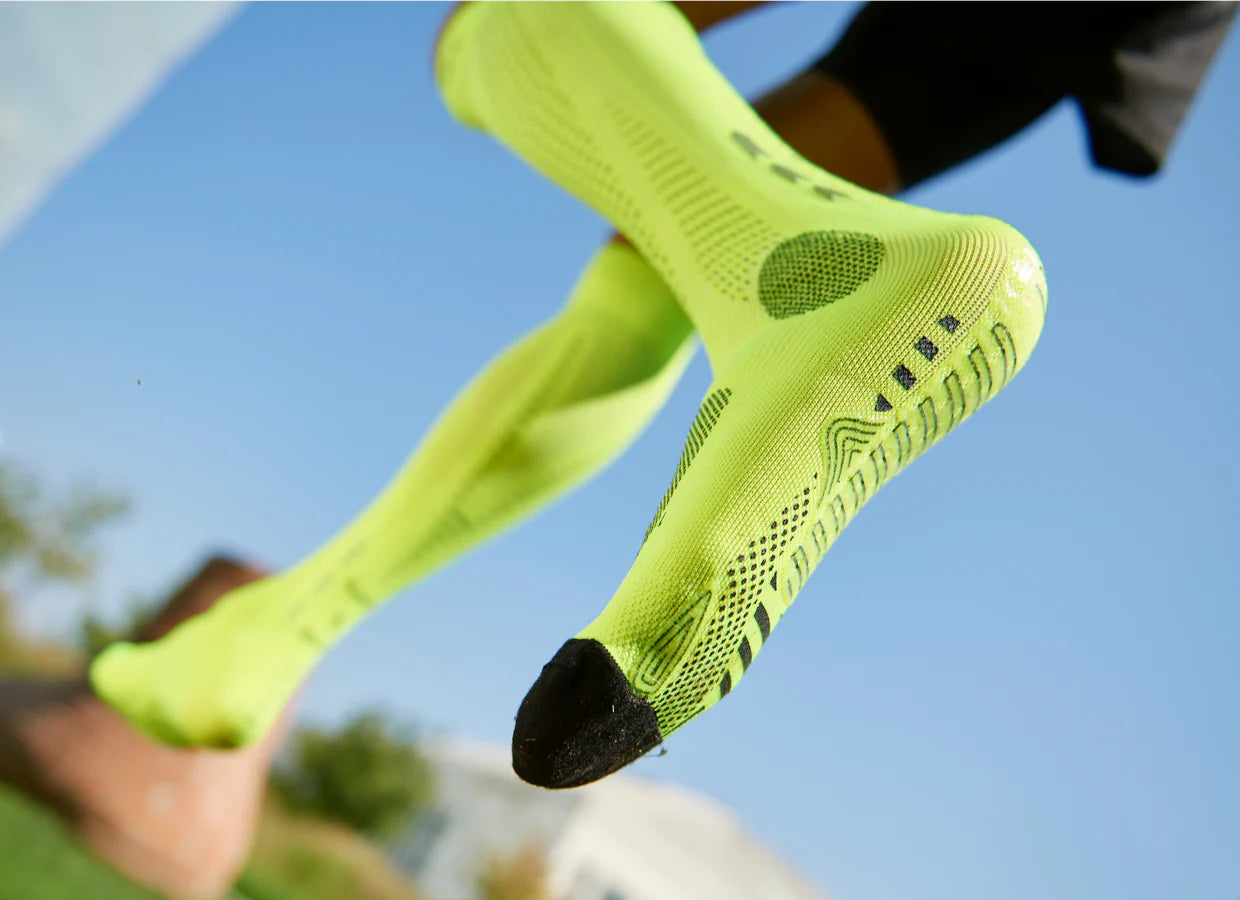
Your Achilles does a lot more than quietly sit at the back of your ankle.
In tennis, padel and pickleball, it is constantly involved in pushing off, stopping, changing direction, jumping, landing, recovering and reacting to the next shot. Every split step, lunge, sprint and sideways shuffle asks the calf and Achilles to absorb force and help you move again.
That is why Achilles support matters in racquet and paddle sports.
Most players think about their shoes first, and fair enough. Court shoes are important. But your socks also play a key role in how your foot feels inside the shoe, how supported your lower leg feels and how confidently you move on court.
A basic sports sock may be fine for casual wear. But court sports place unique demands on the foot, ankle, calf and Achilles. If you play regularly, sock design becomes more than just cushioning and comfort.
At Floky, we approach support through the lens of biomechanics. That means looking at how the body moves as a connected system. For racquet sport athletes, the Achilles is not working alone. It is part of a movement chain that includes the foot, ankle, calf, knee, hip and glutes.
The Floky S-MASH 3D Sock has been designed specifically for racket sports, with support features focused on stability, grip, arch support, comfort, recovery and Achilles tendon protection.
Why the Achilles Matters in Court Sports
The Achilles tendon connects the calf muscles to the heel. It plays a major role in helping you push off the ground, accelerate, decelerate and move explosively.
In court sports, this matters because you are rarely moving in one straight line.
Tennis, padel and pickleball all involve:
-
Split steps
-
Quick push-offs
-
Short sprints
-
Sudden stops
-
Side-to-side movement
-
Lunges
-
Pivots
-
Backward movement
-
Small reactive steps
-
Jumping and landing
-
Recovering after wide shots
Every one of these movements places demand through the calf and Achilles.
The Achilles helps store and release energy as you move. When you push off to chase a ball, recover to the middle, explode forward to the net or brake before a shot, the Achilles is part of that movement.
That is why lower-leg support matters.
You do not need to be an elite athlete for your Achilles to work hard. Even a social pickleball game can involve hundreds of quick reactions and push-offs. The court may be smaller, but the repeated loading adds up.
Achilles Support Is About More Than Injury Prevention
When people hear “Achilles support,” they often think about injuries straight away.
That makes sense. Achilles pain can be frustrating, and anyone who has felt tightness or discomfort in that area knows how much it can affect movement.
But support should not only be thought of after something goes wrong.
Good Achilles support can also be about:
-
Feeling more stable during movement
-
Supporting the lower leg during repeated push-offs
-
Improving comfort inside the shoe
-
Helping the foot feel more secure
-
Supporting confidence during court movement
-
Managing fatigue during longer sessions
-
Creating a better connection between the foot, shoe and court
Support gear will not make the Achilles invincible. It will not replace strength work, recovery, good shoes or sensible training load. But the right sock design may help players feel more comfortable and supported during the movements their sport demands.
Why Sock Design Matters
Most players choose socks based on comfort, thickness or whether they can find a clean pair before leaving the house.
Respectable. Not ideal, but respectable.
For court sports, sock design deserves more attention.
Your sock sits between your foot and your shoe. That means it influences how your foot feels during movement, how much it shifts inside the shoe and how comfortable your lower leg feels during repeated loading.
A court sport sock should help support:
-
Foot stability
-
Arch comfort
-
Grip inside the shoe
-
Lower-leg confidence
-
Achilles comfort
-
Movement control
-
Blister management
-
Repeated changes of direction
This is especially important in tennis, padel and pickleball because the movement is multi-directional.
Running socks are often designed for forward movement. Court socks need to handle side steps, pivots, lunges, braking and explosive push-offs.
That is where a biomechanical sock can offer something more specific than a basic sports sock.
The Biomechanics of the Achilles
The Achilles does not work in isolation.
Every time you move on court, force travels through the body. The foot contacts the ground. The arch helps manage load. The ankle adjusts position. The calf and Achilles help absorb and produce force. The knee, hip and glutes help stabilise and control the movement.
If one part of that chain is not working well, another area may take more stress.
For example:
-
Poor foot stability may increase lower-leg demand
-
Weak calves may make push-offs feel harder
-
Fatigue may reduce ankle control
-
Slipping inside the shoe may reduce confidence
-
Poor arch support may affect foot comfort
-
Hard-court impact may increase lower-leg load
This is why biomechanics matters.
Biomechanics looks at how the body moves, absorbs force and maintains control. In racquet sports, this is especially important because players are constantly reacting, stopping and changing direction.
A sock designed with biomechanics in mind should not just feel soft. It should help support the way your foot and lower leg move during sport.
Achilles Support for Tennis Players
Tennis places major demand through the Achilles and lower leg.
Players cover more court than in padel or pickleball, and rallies can involve repeated wide movements, sprint recoveries, split steps and changes of direction.
Tennis movements that load the Achilles include:
-
Serving and landing
-
Split stepping before returns
-
Sprinting to wide balls
-
Braking before contact
-
Pushing off to recover court position
-
Moving forward to short balls
-
Backpedalling for overheads
-
Lateral movement during baseline rallies
The longer the match, the more fatigue becomes a factor. As players tire, their movement can become less controlled. Footwork gets heavier. Push-offs become less crisp. Recovery steps slow down.
This is where sock support can be helpful.
A tennis sock should help the foot feel stable inside the shoe, support the arch and provide a secure feel around the Achilles and lower leg.
The S-MASH 3D Sock is designed for the movement demands of racket sports, making it a strong option for tennis players who want more than basic cushioning.
Achilles Support for Padel Players
Padel is compact, fast and reactive.
Unlike tennis, padel involves constant movement in tight spaces, quick volleys, defensive reactions, rebounds off the glass and explosive net play.
Padel players regularly deal with:
-
Fast push-offs
-
Short reaction steps
-
Sudden stops
-
Direction changes
-
Pivots
-
Jumping or reaching for smashes
-
Moving backwards after lobs
-
Repositioning quickly near the glass
These movements can place a lot of repeated demand through the calf and Achilles.
Because padel points can be fast and unpredictable, players need to feel secure in their footwork. If the foot shifts inside the shoe, or the lower leg feels unsupported, movement can feel less confident.
This is why a padel sock should support grip, stability and Achilles comfort.
The S-MASH 3D Sock is especially relevant for padel because it is designed for racket sport movement and court stability. For players dealing with fast directional changes and repeated push-offs, that support-focused design makes sense.
Achilles Support for Pickleball Players
Pickleball may look gentler than tennis, but the lower leg still works hard.
The court is smaller, but the movement is sharp and repetitive. Players are constantly reacting at the kitchen line, shuffling sideways, lunging low, pushing off and stopping quickly.
Pickleball movements that can load the Achilles include:
-
Split steps
-
Short sprints
-
Side shuffles
-
Low lunges
-
Quick recovery steps
-
Pivots
-
Sudden stops
-
Push-offs from the kitchen line
Because pickleball is easy to start, many players increase their volume quickly. Someone might go from playing once a week to playing several times a week, especially once they get hooked. Which usually takes about four points and one questionable line call.
That sudden increase in playing volume can place new demand on the calves, ankles and Achilles.
For pickleball players, supportive socks can help the foot and lower leg feel more secure during fast court movement.
The S-MASH 3D Sock may be a strong option for players who want more support, stability and comfort than a regular sports sock provides.
What to Look for in Achilles Support Socks
If you are choosing socks for tennis, padel or pickleball, look beyond basic cushioning.
The best socks for Achilles support should be designed for court movement.
1. Achilles Tendon Support
If Achilles support is the goal, the sock should be designed to support the back of the ankle and lower leg area.
The S-MASH 3D Sock includes Achilles tendon protection as one of its key support features, making it a strong fit for players who want a more secure feel around this area during sport.
2. Foot Stability
The Achilles works closely with the foot and ankle. If the foot feels unstable inside the shoe, the lower leg may have to work harder to control movement.
Look for socks that help the foot feel secure during quick changes of direction, braking and push-off.
3. Arch Support
The arch helps manage load through the foot.
During court sports, the arch is repeatedly loaded as you stop, start, lunge and change direction. A sock with arch support may help the foot feel more stable and comfortable during play.
The S-MASH 3D Sock includes arch support, which is particularly relevant for players who want more structure than a standard sock provides.
4. Grip Inside the Shoe
Court movement creates a lot of force inside the shoe.
If the sock slips, bunches or allows the foot to slide around, movement can feel less controlled. This can also create friction and discomfort.
A good court sock should help the foot feel connected inside the shoe.
5. Comfort During Long Sessions
Support only matters if the sock is comfortable enough to wear.
Tennis matches, padel sessions and pickleball tournaments can all involve long periods on court. The sock should feel good across the whole session, not just when you first put it on.
6. Blister Management
Repeated court movement can create friction, especially during lateral movement and braking.
A good sock should help reduce unnecessary rubbing and keep the foot more secure inside the shoe.
7. Sport-Specific Design
Not every sports sock is designed for racquet and paddle sports.
Court athletes need support for multi-directional movement. That means the sock should be suited to side steps, pivots, lunges, short sprints and sudden stops.
This is where the S-MASH 3D Sock stands out: it is designed specifically for racket sports, not just general exercise.
Why Biomechanical Sock Design Matters
A standard sports sock mostly focuses on comfort.
A biomechanical sock should go further.
It should consider how the foot moves inside the shoe, how the lower leg absorbs force and how the athlete changes direction during sport.
For tennis, padel and pickleball, that matters because the foot and ankle are constantly adjusting.
Every point involves a series of small movement decisions:
-
Where do I step?
-
How do I brake?
-
How do I push off?
-
How do I recover?
-
How do I stay balanced?
-
How do I prepare for the next shot?
Your socks are part of that system.
The Floky S-MASH 3D Sock is designed to act as a support layer between the foot, shoe and court. Its biomechanical design aims to support grip, stability, arch comfort and Achilles protection during racket sport movement.
That makes it different from a basic sock that only provides cushioning.
S-MASH 3D: A Sock Designed for Court Stability
The S-MASH 3D Sock is built for tennis, padel and pickleball players who want more support from their socks.
Its key support features include:
-
Achilles tendon protection
-
Arch support
-
Enhanced grip
-
Bandage and stability support
-
Comfort and recovery
-
Support for intense court movements
For court athletes, these features map directly to the way the body moves.
For Quick Direction Changes
Racquet sports are full of sharp movements. You need to stop, push off and move again quickly.
A sock that supports grip and foot stability may help you feel more confident during these movements.
For Push-Offs and Acceleration
The Achilles and calf are heavily involved when you push off the ground.
S-MASH 3D’s Achilles support and foot stability features make it relevant for players who rely on repeated acceleration.
For Lateral Movement
Side-to-side movement is a major part of tennis, padel and pickleball.
A stable sock can help the foot feel more secure inside the shoe during shuffles, pivots and wide recovery steps.
For Longer Sessions
As fatigue builds, support and comfort become more important.
A sock designed for stability, grip and comfort may help players feel more supported across longer matches or repeated games.
How Socks Fit Into a Broader Achilles Support Strategy
Socks matter, but they are only one part of the picture.
If you want to support your Achilles for court sports, you should also think about:
-
Proper court shoes
-
Gradual increases in playing volume
-
Calf strength
-
Ankle mobility
-
Warm-ups
-
Recovery between sessions
-
Managing fatigue
-
Avoiding sudden spikes in intensity
-
Seeking professional advice for persistent pain
Support gear can help you feel more comfortable and confident, but it cannot replace smart preparation.
If your Achilles is sore every time you play, or pain is getting worse, do not just add better socks and hope for the best. Hope is not a rehab plan. Annoying, but true.
When to Consider Achilles Support Socks
Achilles support socks may be worth considering if you:
-
Play tennis, padel or pickleball regularly
-
Feel lower-leg fatigue during or after play
-
Want more support around the ankle and Achilles area
-
Notice your foot moving inside your shoe
-
Play long matches or tournaments
-
Often play on hard courts
-
Want more arch support
-
Want a more stable feel during push-offs
-
Are increasing your playing volume
-
Want socks designed specifically for racket sport movement
If you only play casually once in a while, regular sports socks may be enough.
But if you train, compete or play regularly, supportive socks can be a smart part of your court setup.
Common Mistakes When Choosing Court Socks
Choosing Any Thick Sock
Thicker does not always mean better.
A thick sock might feel cushioned, but it may not provide the stability, grip or support needed for court movement.
Ignoring the Achilles and Arch
Many players focus only on cushioning under the foot.
But the Achilles, arch and ankle all play major roles in court movement. A good sock should support more than just the sole.
Wearing Running Socks for Court Sports
Running socks are often designed for forward motion. Tennis, padel and pickleball involve movement in every direction.
Court athletes need socks that can handle lateral movement, pivots, lunges and sudden stops.
Not Thinking About Foot Movement Inside the Shoe
Even good shoes can feel less stable if the sock allows the foot to slide around.
A secure sock can help improve comfort and confidence inside the shoe.
Waiting Until Pain Appears
Support does not only matter after pain begins.
If you play regularly, choosing supportive gear early can help you feel more prepared for the demands of the sport.
When to Seek Professional Advice
Achilles discomfort should be taken seriously, especially if it is persistent or worsening.
Speak with a doctor, physiotherapist or qualified health professional if you experience:
-
Sharp Achilles pain
-
Pain that worsens during play
-
Pain first thing in the morning
-
Swelling around the Achilles
-
Pain after a sudden push-off or landing
-
Difficulty walking normally
-
Pain that keeps returning
-
Symptoms that do not improve with rest
-
Pain that changes the way you move
Supportive socks can be part of your toolkit, but they should not be used to ignore pain that needs proper assessment.
Final Thoughts
The Achilles plays a major role in tennis, padel and pickleball.
Every split step, lunge, push-off, sprint, pivot and recovery movement asks the calf and Achilles to work. That is why sock design matters more than many players realise.
The best socks for court sports should offer more than basic cushioning. They should support stability, grip, arch comfort, Achilles protection and confidence during multi-directional movement.
The Floky S-MASH 3D Sock is designed specifically for racket sports, with biomechanical support features built around how players move on court.
For tennis, padel and pickleball players who want more comfort, support and control, S-MASH 3D is a smarter choice than a basic sports sock.
Explore the Floky S-MASH 3D Sock — biomechanical Achilles, arch and foot support for racquet and paddle sport athletes.