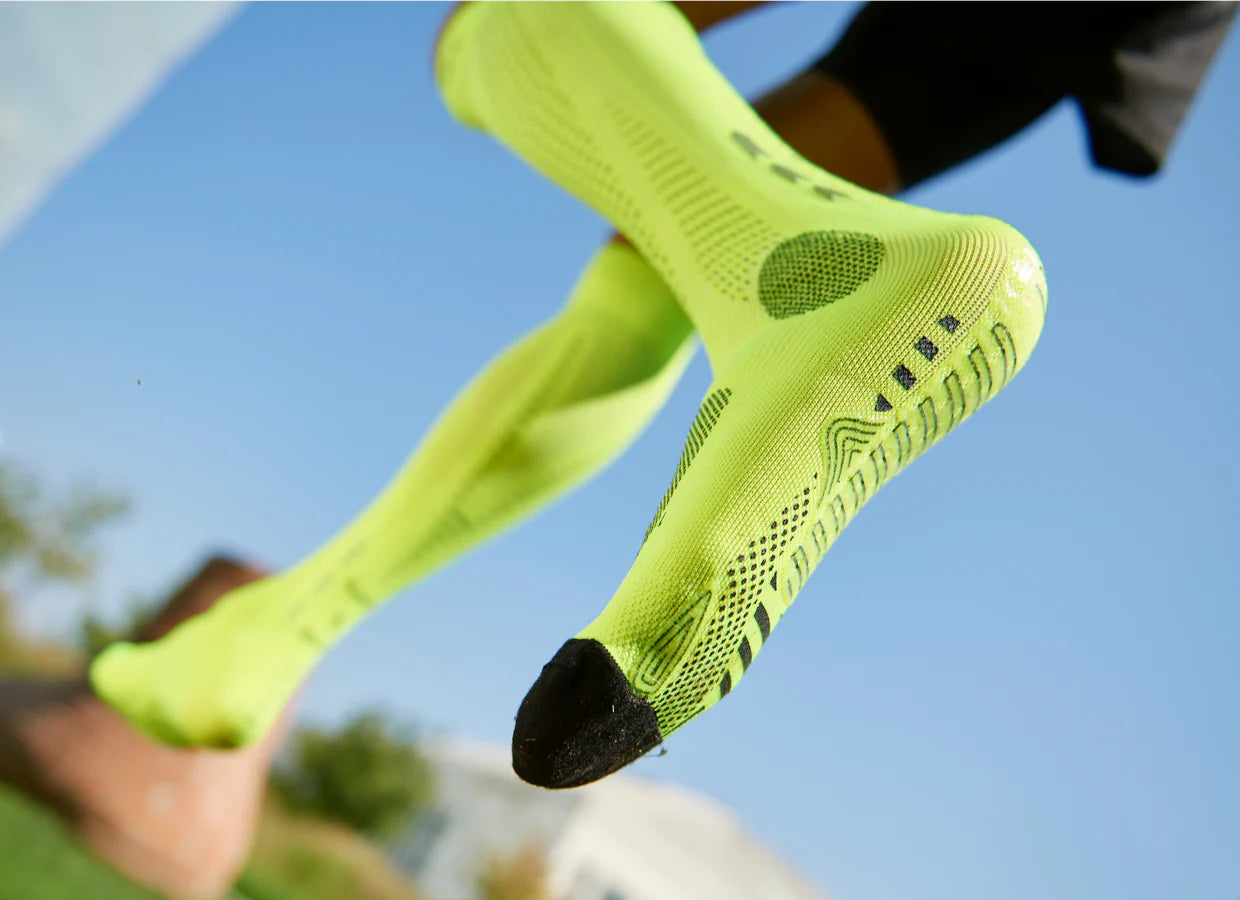
If you have spent any time around runners, footballers, or padel courts lately, you have probably noticed compression socks everywhere. So why wear compression socks at all, and do they actually do anything, or are they just a trend? The short answer is that the right compression sock can support how your body moves and recovers. The longer answer is more interesting, and it comes down to biomechanics.
This guide explains what compression socks are, why athletes wear them, what they are commonly used for, and why Floky’s biomechanical approach offers a more considered form of support than basic compression alone.
What are compression socks?
Compression socks are close-fitting garments that apply gentle, measured pressure to the lower leg and foot. Most performance socks use graduated compression, meaning the pressure is highest at the ankle and eases as it moves up the calf. That gradient is the point: it encourages blood to flow back up the leg toward the heart rather than pooling around the ankle, working with your circulation instead of just squeezing the leg.
Compression is measured in millimetres of mercury (mmHg). Most sports socks sit in the 15 to 30 mmHg range, which is firm enough to make a difference during activity without restricting movement.
It is worth knowing this baseline, because it is also where most brands stop. A standard compression sock squeezes the whole leg evenly and leaves it there. Floky takes that same proven compression and builds on it, adding a biomechanical layer designed to support specific muscles and joints rather than treating the leg as one uniform shape. More on how that works below, but it is the key difference to keep in mind as you read on.
Why do athletes wear compression socks?
Athletes reach for compression socks for four broad reasons. Each is grounded in how the leg behaves under load.
1. Better circulation and oxygen delivery
Graduated compression supports venous return, the flow of blood back to the heart against gravity. More efficient circulation means working muscles are supplied with oxygen more readily, which can help delay the onset of fatigue during longer efforts. After exercise, the same effect helps clear metabolic by-products that build up while you train or compete.
2. Less muscle vibration
Every time your foot strikes the ground, soft tissue in the calf vibrates and oscillates. Over thousands of steps, that repeated micro-movement contributes to fatigue and small-scale muscle damage. Compression dampens this oscillation, holding the muscle more steadily so it absorbs impact with less wasted movement. This is one of the clearer biomechanical benefits researchers point to.
3. Faster, more comfortable recovery
This is where the evidence is strongest. Studies consistently show that wearing compression after exercise can reduce swelling, ease muscle soreness, and improve markers of recovery. For athletes training day after day, recovering well between sessions matters as much as any single workout.
4. Joint stability and body awareness
Compression around the ankle and calf increases proprioception, your body’s sense of where its limbs are in space. Research has linked compression to improved balance reactions and steadier movement, which can translate into better joint stability and more controlled mechanics, especially as you fatigue.
What are compression socks commonly used for?
The same properties make compression socks useful across a wide range of activities and goals:
-
Endurance sport: runners, cyclists, and triathletes use them to manage fatigue over long distances and recover between sessions.
-
Court and field sport: footballers, tennis, padel, pickleball, basketball, and volleyball players value support during quick, repeated changes of direction.
-
Recovery: worn after training or on rest days to reduce soreness and swelling.
-
Travel and long days on your feet: compression helps prevent the heavy, swollen-leg feeling from long periods of sitting or standing.
-
Injury support: alongside guidance from a health professional, compression can be part of managing joint and soft-tissue niggles.
The limits of basic compression
Here is the honest part. Most compression socks apply pressure fairly uniformly around the leg. That uniform squeeze delivers the circulation and vibration benefits above, but it treats the leg as a single shape rather than a system of specific muscles, tendons, and joints that each do different jobs. A calf muscle driving you forward and an ankle stabilising a sideways cut have very different needs, and plain compression cannot tell them apart.
It is also worth being realistic about performance. Research is clear that compression helps recovery, while its effect on raw performance during exercise is mixed and varies between individuals. So the goal is not a magic speed boost. It is targeted, intelligent support for how you actually move.
How Floky goes beyond basic compression
Floky is built around a different idea. Rather than relying on compression pressure alone, every Floky garment uses biomechanical screen-printing, a precise pattern printed directly onto the compression fabric. That pattern is designed to interact with your musculoskeletal system to activate and stabilise specific muscles, support circulation, reduce fatigue, and speed up recovery. Think of it as the evolution of compression: the proven benefits of a compression garment, plus targeted support that a regular sock simply cannot provide.
In other words, Floky maps support to the body rather than applying one even squeeze. This is why the brand’s guiding question is simply, “Where do you need support?” A running sock, a soccer sock, and a racquet-sport sleeve are each printed for the demands of that activity. The result is a more considered form of support: compression doing the basics, plus a biomechanical layer working with how you move.
Floky’s range spans running socks, soccer and racquet-sport socks, joint supports for the knee, ankle and elbow, recovery wear, and postural apparel, with an overall 4.6 out of 5 rating across more than 1,600 reviews and an official partnership with Pickleball Australia.
Getting the most from your compression socks
Whether you choose a basic sock or a biomechanical one, a few habits make a real difference to how much benefit you feel:
-
Size them properly. Compression is only effective in the correct size. Measure your calf and shoe size and follow the product’s size guide rather than guessing.
-
Put them on early. Pull them on before activity so they are supporting your circulation and muscles from the first minute, not halfway through.
-
Use them for recovery too. Slipping them on after a hard session, or on a rest day, is where the evidence for reduced soreness and swelling is strongest.
-
Care for the fabric. Wash gently and avoid high heat so the compression and any biomechanical printing keep their structure over time.
Done consistently, these small things are the difference between a sock that looks the part and one that genuinely supports how you train and recover.
Frequently asked questions
Should I wear compression socks during or after exercise?
Both work. Worn during activity, they support circulation and reduce muscle vibration; worn afterward, they are most strongly linked to reduced soreness and faster recovery. Many athletes do both.
Are compression socks safe to wear every day?
For most healthy people, sports-level compression is fine for training, recovery, and long days on your feet. If you have a circulatory condition, diabetes, or any vascular concern, check with your doctor first.
How tight should they feel?
Firm and supportive, never painful. They should not pinch, leave deep marks, or cut off circulation. Getting the right size is essential, which is why Floky offers size guidance for each product.
The takeaway
So, why wear compression socks? Because the right pair supports your circulation, steadies your muscles under load, and helps you recover faster, all grounded in biomechanics rather than hype. And if you want support designed for how you actually move rather than a uniform squeeze, Floky’s biomechanical approach is built for exactly that. Explore the range at floky.com.au and find the support you need, where you need it.
References
Journal of Sport Rehabilitation, systematic review (2025)
BMC Sports Science, Medicine & Rehabilitation: sensory feedback and balance
Journal of Science and Medicine in Sport: compression during exercise
Scientific Reports: proprioception and dynamic balance during running