If you already train hard, you do not need convincing that compression socks for athletes are worth wearing. You have felt the difference: fresher legs late in a session, less of that heavy, trashed feeling the morning after. The real question is no longer whether to wear compression, but how to get more from it. That is where biomechanics comes in. Floky represents the next step in the thinking: where most brands offer general compression, Floky offers targeted compression, engineered to deliver greater results than a standard compression garment can. It is less a different product than the evolution of one you already trust.
What athletes expect from compression
Most performance socks deliver a familiar set of benefits, and the science backs them up:
-
Improved venous return, so blood and oxygen move through working muscles more efficiently and fatigue arrives later.
-
Reduced muscle oscillation, dampening the vibration that builds up over thousands of foot strikes and contributes to micro-damage.
-
Faster recovery, the most strongly evidenced benefit, with less swelling and soreness between sessions.
-
Better proprioception and balance, helping you stay coordinated and stable as you fatigue.
These are real and worth having. But notice that they all flow from one mechanism: even pressure around the leg. For an athlete chasing marginal gains, that raises an obvious question: is uniform pressure really the best a sock can do?
The biomechanics of how you move
Your lower leg is not one structure performing one job. When you run, your calf complex acts like a spring, storing and returning energy with every stride. When you cut, plant, or jump, your ankle and the surrounding stabilisers work to keep the joint controlled under sideways and rotational load. Sprinting, decelerating, and landing each recruit different muscles in different patterns.
A standard compression sock applies the same pressure to all of it. It supports the leg as a shape, not as a system. Biomechanics asks a sharper question: what if support could be matched to the specific muscles and joints doing the work, in the way that activity demands? That is the gap Floky was built to close.
This also explains why fatigue is such a key moment for athletes. As you fatigue, your mechanics drift: your stride shortens, your landings get sloppier, and your sense of joint position fades. That breakdown in form does more than cost performance. It raises your risk of injury, because tired, poorly controlled movement loads your muscles and joints in ways they are not braced for. Research on proprioception during running shows that compression can help maintain body awareness in the earlier stages of an effort, even if longer efforts still demand good conditioning. Support that targets the right structures gives you a better chance of holding your form together when it matters most: in the closing minutes of a match or the back end of a long run.
Floky’s point of difference: biomechanical screen-printing
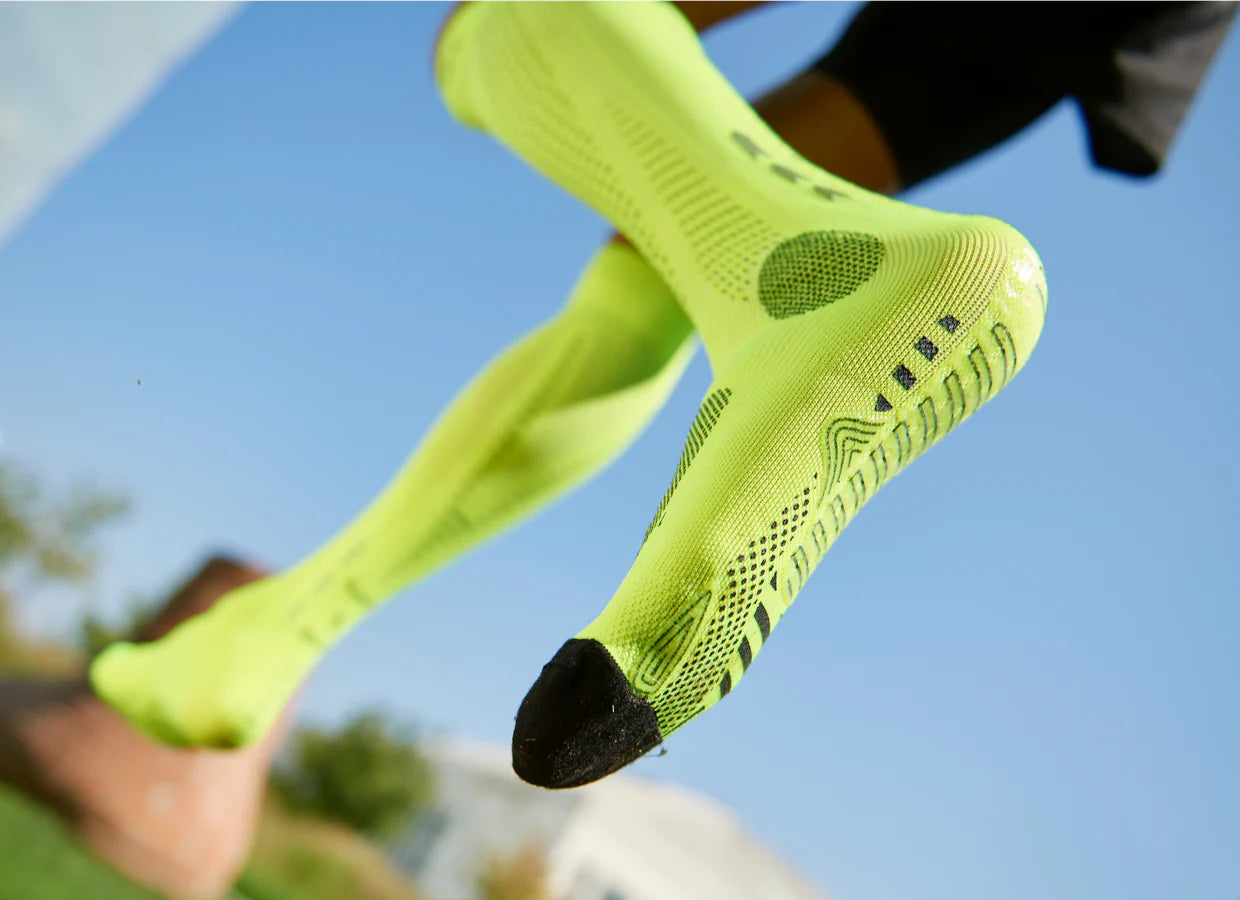
Floky starts with quality graduated compression, so you get the circulation, vibration and recovery benefits every athlete expects. Then it adds the part no basic sock has: a biomechanical screen-printed pattern applied directly to the fabric. This is the point of difference. A regular compression sock can only squeeze the leg evenly, whereas the printed pattern turns the garment into active, targeted support that works with specific muscles and joints. It is the line that separates Floky from conventional compression wear: same trusted compression base, plus a biomechanical layer built on top.
This printed pattern is engineered to interact with your musculoskeletal system rather than simply compress it. It is designed to:
-
Activate and stabilise targeted muscles during movement, so support lands where the load actually is.
-
Improve circulation and blood flow to keep oxygen reaching working tissue.
-
Reduce fatigue and the risk of injury by supporting more controlled mechanics.
-
Speed up recovery after you train or compete.
The brand sums it up in one question: “Where do you need support?” Instead of one sock that squeezes everything equally, Floky designs each product for the movement patterns of a specific sport. That is what it means for biomechanics to change the way you move: support that adapts to your activity instead of the other way around.
Matching the sock to your sport
Because demands differ by sport, Floky’s range is built around them:
-
Running: the RUN UP socks (long, medium and short) support the calf and ankle through repetitive impact and help manage fatigue over distance.
-
Soccer: AXSIST and KINETICA socks plus TACKLE shin guards target stability and injury prevention during sprints, cuts and tackles.
-
Tennis, pickleball and padel: the S-MASH and S-PRINT socks and NO STRAIN sleeve support the quick lateral movement and bracing these racquet sports demand. Floky is also the official partner of Pickleball Australia.
-
Basketball and volleyball: the JUMPER and S-MASH 3D socks are built for repeated jumping and landing loads.
-
Recovery and joint support: the RE-CHARGE sock plus dedicated knee, ankle and elbow supports help you bounce back and protect vulnerable joints.
Choosing compression socks as an athlete
A few things separate a sock that helps from one that just sits on your leg:
-
Fit first. Compression only works at the right size. Too loose and you lose the benefit; too tight and it restricts movement. Use the size guide for each product.
-
Match it to your activity. A sock printed for lateral court movement is doing different work than one built for straight-line running. Choose for your sport.
-
Think in pairs of timing. Train in them for in-session support, then use recovery wear afterward. Recovery is where compression’s evidence is strongest.
-
Judge it on movement, not just squeeze. The point of biomechanical support is how controlled and fresh you feel through a full session, not how tight the sock is at rest.
Frequently asked questions
Do compression socks actually improve athletic performance?
The strongest, most consistent evidence is for recovery: reduced soreness and swelling after exercise. Effects on in-the-moment performance are more mixed and vary between athletes. Floky’s biomechanical design focuses on targeted support and recovery rather than promising a raw speed increase.
What makes Floky different from regular compression socks?
Regular socks rely on compression pressure alone. Floky adds biomechanical screen-printing, a pattern engineered to activate and stabilise specific muscles for a given sport, on top of graduated compression. It is support mapped to movement, not a uniform squeeze.
Can I wear them for more than one sport?
You can, but you will get the most from a sock designed for your primary activity, since the biomechanical pattern is tuned to that sport’s movement demands.
The bottom line
Compression socks for athletes have earned their place: better circulation, less muscle vibration, and faster recovery are well supported. But basic compression treats your leg as one shape. Floky treats it as a system, using biomechanical screen-printing to put support exactly where your sport demands it. If you want compression that works with the way you move, explore Floky’s range at floky.com.au and find the support you need.
References
Journal of Sport Rehabilitation, systematic review (2025)
BMC Sports Science, Medicine & Rehabilitation: sensory feedback and balance
Journal of Science and Medicine in Sport: compression during exercise
Scientific Reports: proprioception and dynamic balance during running