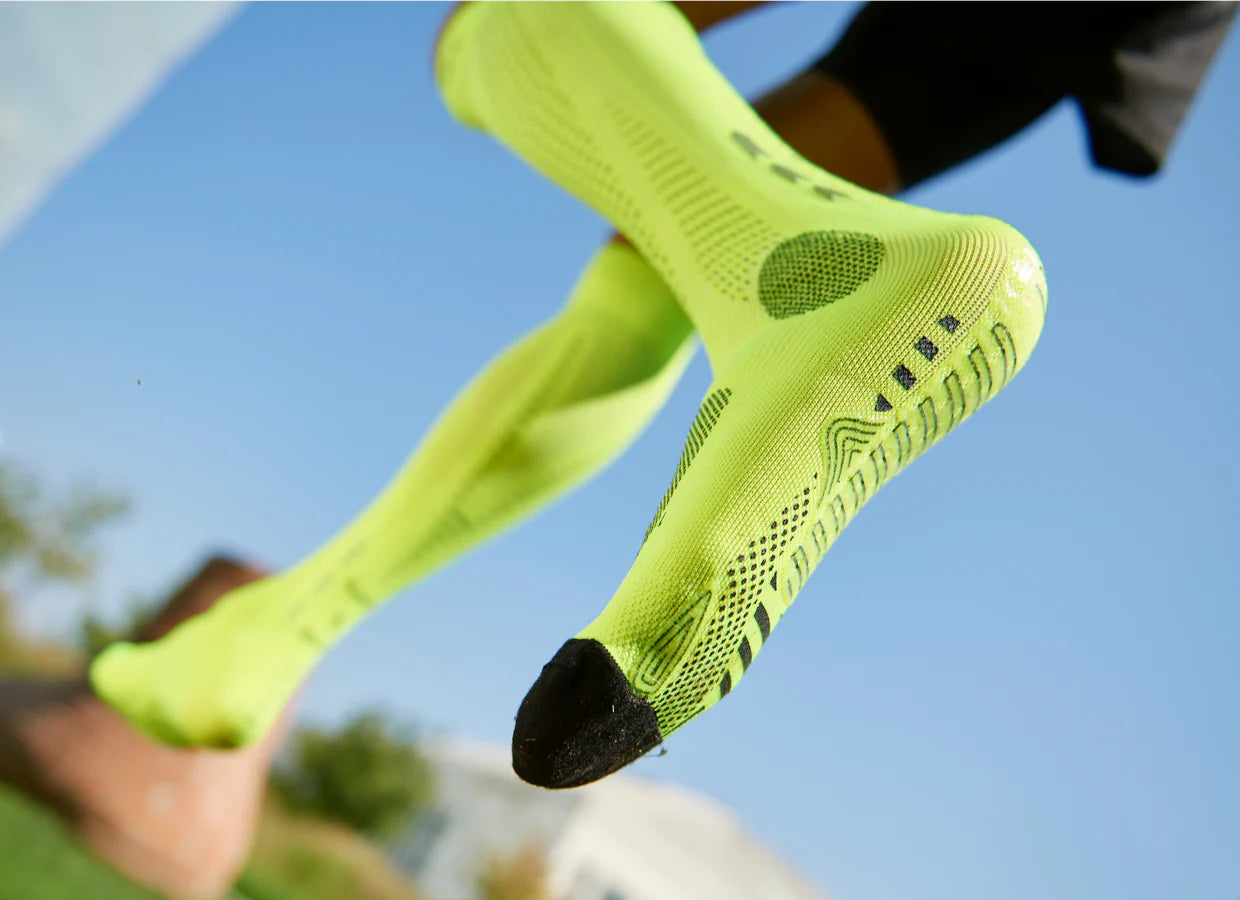
Trail running is not just road running with better views.
The surface changes constantly. One minute you are climbing, the next you are descending, dodging rocks, stepping over roots, landing on loose gravel or trying to look composed while your ankles negotiate with gravity.
That is what makes trail running so rewarding, but also what makes it more demanding on the body.
Unlike running on a flat road or treadmill, trail running asks your feet, ankles, calves, shins, knees, hips and glutes to constantly adjust. Every step can be slightly different. That means your body needs to absorb force, stabilise, react and keep moving with control.
This is one of the reasons runners search for trail compression socks. They are not just looking for another pair of running socks. They are often looking for more support, more comfort and more confidence when the terrain becomes unpredictable.
At Floky, we look at support through the lens of biomechanics. That means thinking about how the body moves as a connected system, not just how much compression can be applied to one area.
For trail runners, that difference matters.
Why Trail Running Places More Demand on the Body
Road running is repetitive. Trail running is repetitive chaos with scenery.
On a road, each foot strike tends to be more predictable. The surface is usually flat, stable and consistent. On trails, every stride may ask something different from the body.
Trail running often involves:
-
Uneven surfaces
-
Rocks, roots and loose ground
-
Constant changes in foot placement
-
More ankle movement
-
More calf and shin demand
-
Uphill force production
-
Downhill braking forces
-
Side-to-side movement
-
Greater stabilisation demands
-
Fatigue over longer or more technical routes
This creates a different type of load through the lower body.
Your feet and ankles have to adjust quickly. Your calves and shins help manage impact and control. Your knees and hips help stabilise your body over changing terrain. Your glutes and core help keep everything moving efficiently.
When fatigue sets in, this becomes harder. That is often when runners start to feel less stable, less controlled or more aware of discomfort through the lower legs.
That is where support can be useful.
What Are Trail Compression Socks?
Trail compression socks are running socks designed to provide a supportive compression feel through the foot, ankle, calf or lower leg, depending on the design.
Runners often use them because they want more than basic comfort. They want a sock that can help provide support during longer runs, uneven terrain, climbs, descents and repeated lower-leg loading.
Trail compression socks may be used for:
-
Lower-leg support
-
Calf and shin comfort
-
A more secure feeling while running
-
Warmth in cooler conditions
-
Confidence on uneven terrain
-
Support during longer trail sessions
-
Recovery-focused use after running
-
Better awareness of the lower leg during movement
They do not replace smart training, strength work, proper footwear or recovery. But the right compression support may help runners feel more comfortable, stable and confident when moving across unpredictable surfaces.
The Biomechanics of Uneven Terrain
Trail running is a biomechanical challenge because the body is constantly adapting.
Every step requires your body to make small adjustments based on the surface underneath you. A slightly angled rock, a loose patch of dirt or a downhill landing can change how force travels through the lower body.
On trails, your body has to manage:
-
Changing ground angles
-
Sudden shifts in direction
-
More ankle movement
-
Increased calf and shin stress
-
Uphill pushing
-
Downhill braking
-
Lateral movement
-
Balance corrections
-
Fatigue affecting control
The lower leg plays a major role in all of this.
Your foot and ankle respond to the ground. Your shin and calf help absorb and control force. Your knee and hip guide the leg position. Your glutes and core help stabilise the whole system.
This is why biomechanics matters.
Biomechanics is the study of how the body moves. For trail runners, it helps explain why support should not only be about compression. It should also be about comfort, control and how the body responds to changing terrain.
Floky’s approach is built around this idea.
Biomechanical compression is support designed around movement, not just pressure. It is about helping athletes feel more connected, stable and confident while still allowing the body to move naturally.
Why Compression Can Be Useful for Trail Runners
Compression socks can support trail runners in a few practical ways.
Lower-Leg Support
Compression creates a firm, supportive feel around the lower leg. For trail runners, this can be helpful because the calves, shins and ankles are constantly working to respond to the terrain.
A supportive sock may help the lower leg feel more secure during longer or more technical runs.
Proprioceptive Feedback
Proprioception is your body’s awareness of where it is in space.
When you run on trails, your body needs constant feedback. Your foot position, ankle angle, knee position and balance are changing from step to step.
Compression can provide sensory feedback to the body. This may help runners feel more aware of their lower-leg position and movement, which can be valuable on uneven terrain.
Warmth and Comfort
Trail runs often start early, finish late or take place in cooler conditions. Compression socks can help maintain warmth around the lower leg, which some runners find more comfortable during longer sessions.
Comfort matters. Especially when you are an hour into a trail run and your only choices are keep moving or befriend a shrub.
Confidence Over Distance
Trail running often gets harder as fatigue builds. The longer you are out there, the more important comfort and confidence become.
A supported lower-leg feel may help runners feel more in control, particularly during longer sessions, hilly routes or technical terrain.
Recovery Support
Some runners also use compression gear after trail runs as part of their recovery routine. While compression is not a magic recovery shortcut, many athletes like the supported feeling it provides after demanding sessions.
Trail Compression Socks vs Regular Running Socks
Regular running socks and trail compression socks can both be useful, but they serve slightly different purposes.
| Feature | Regular Running Socks | Trail Compression Socks |
|---|---|---|
| Main purpose | General comfort | Comfort plus lower-leg support |
| Compression | Usually minimal | Designed to provide a supportive feel |
| Best suited for | Road, gym or short runs | Trails, hills, longer sessions and uneven terrain |
| Lower-leg support | Limited | Greater support through the calf and shin area |
| Terrain demands | Predictable surfaces | Changing, uneven and technical surfaces |
| Runner focus | Comfort and fit | Comfort, support and confidence |
Some runners may prefer standard running socks for short, easy sessions. But when the terrain becomes more demanding, compression socks can provide a more supported lower-leg feel.
For trail runners, that extra support can be especially useful during hills, descents, longer sessions and uneven surfaces.
What to Look for in Trail Compression Socks
Not all compression socks are designed with trail running in mind. If you are choosing trail compression socks, look for support that feels comfortable, secure and movement-friendly.
Comfortable Compression
Compression should feel firm without being restrictive. You want support, not a sock that feels like it is trying to win an argument with your calf.
If compression causes numbness, tingling or discomfort, it is not the right fit.
Lower-Leg Coverage
For trail running, support through the calf and shin area can be useful because these areas work hard on uneven terrain.
Look for socks that provide a secure and supportive feel through the lower leg.
Secure Fit
Trail runs involve climbs, descents, lateral movement and changes in pace. A sock that slips or bunches can quickly become distracting.
A secure fit helps the sock stay comfortable while you move.
Breathable Material
Trail running can involve heat, sweat, mud, cold mornings and long sessions. Breathable materials help keep the sock more comfortable over time.
Durability
Trail running is tougher on gear than smooth road running. Look for socks designed for repeated use and athletic movement.
Movement-Friendly Design
Support should never make running feel awkward. The best compression socks should move with the body while still helping create a more stable, supported feeling.
Biomechanical Support
This is where Floky’s point of difference comes in.
Generic compression is mostly about pressure. Biomechanical support considers how the body moves, responds and stabilises.
For trail runners, this is important because every stride is slightly different. Support needs to feel natural, comfortable and useful across changing terrain.
When Trail Compression Socks May Be Most Useful
Trail compression socks may be useful when runners want extra lower-leg support, comfort or confidence.
This may include:
-
Long trail runs
-
Hilly routes
-
Technical terrain
-
Downhill-heavy sessions
-
Cooler conditions
-
Race day
-
Higher-volume training blocks
-
Recovery runs
-
Runs where calves or shins feel heavily loaded
-
Sessions where uneven terrain makes movement feel less predictable
They may also be useful for runners transitioning from road to trail, because trail running often places new demands on the lower body.
The key is to use compression support as part of a smarter approach to training, not as a replacement for preparation.
Floky Options for Trail Running Support
Floky’s approach is built around biomechanical compression and support for active movement.
For trail runners, Floky compression socks are the most relevant starting point. They are designed to provide a supportive lower-leg feel, making them a strong option for runners who want comfort, control and confidence through the calf and shin area.
They may be useful for:
-
Trail running
-
Road running
-
Lower-leg support
-
Training blocks
-
Longer runs
-
Recovery-focused use
-
Runners wanting a more supported feel
For athletes who want broader lower-body compression, the HYPER Man Leggings and HYPER Woman Leggings are also relevant options. These leggings are designed for stability and recovery, with support through areas including the knees, glutes and surrounding muscle groups.
They may be useful for colder trail sessions, longer training days, gym-to-run sessions or post-run recovery.
For runners who want specific support around the knee, the Floky Knee Support Knee Brace may also be worth considering. Trail running can place extra demand on the knees, especially during descents and uneven terrain. A targeted knee support can help provide a more secure feeling around the knee and patella during movement.
A simple way to choose:
-
Choose Floky Compression Socks if your main focus is lower-leg, calf or shin support.
-
Choose HYPER Man Leggings if you want full lower-body compression, stability and recovery support for men.
-
Choose HYPER Woman Leggings if you want full lower-body compression, stability and recovery support for women.
-
Choose the Knee Support Knee Brace if your main focus is targeted knee support on trails.
The goal is not just to wear more compression. The goal is to choose support that matches how and where you move.
Trail Running Support Still Starts With Training
Compression support can be useful, but it cannot do all the work for you.
Trail running places unique demands on the body, so preparation matters. The stronger and more prepared your body is, the better it can handle uneven terrain.
Helpful training habits include:
-
Building trail volume gradually
-
Strengthening calves, ankles, hips and glutes
-
Practising downhill running carefully
-
Wearing suitable trail shoes
-
Managing fatigue
-
Recovering between hard sessions
-
Learning efficient foot placement
-
Reducing load when pain appears
-
Avoiding sudden jumps in distance, hills or technical terrain
Support gear can help you feel more comfortable and confident, but your body still needs time to adapt.
Good training plus good support is the real combination.
Common Mistakes Trail Runners Make With Support Gear
Support gear can help, but it works best when used properly.
Waiting Until Pain Is Already Bad
Many runners only think about support once something starts hurting. While support can still be useful, it is often better to think about comfort and recovery before discomfort becomes a bigger issue.
Wearing Compression That Is Too Tight
More compression does not always mean better support. If your socks are painfully tight or distracting, they may not be right for you.
Compression should feel secure, not restrictive.
Using Gear to Ignore Load Management
Trail running is demanding. If your calves, shins or knees are constantly sore, support gear might help you feel better, but it does not replace recovery or sensible training load.
Choosing Gear That Does Not Match the Terrain
Road running gear is not always ideal for trails. Trail running often requires support that can handle more varied movement, longer sessions and uneven ground.
Forgetting the Whole Movement Chain
If your shin, knee or ankle is uncomfortable, the issue may not only be at that spot. The way your foot, calf, hip and glutes are working can all affect how your body handles trail running.
This is why a biomechanical view is useful.
When to Seek Professional Advice
Trail running comes with uneven surfaces, fatigue and impact, so it is important to pay attention to pain signals.
Speak with a doctor, physiotherapist or qualified health professional if you experience:
-
Sharp or worsening pain
-
Swelling
-
Pain that changes your running style
-
Pain that affects walking
-
Knee, shin or ankle pain that persists
-
Instability or giving way
-
Pain after a fall, twist or impact
-
Pain that keeps returning every time you run
Compression socks and support gear can be part of your running toolkit, but they should not be used to ignore pain that needs proper assessment.
Final Thoughts
Trail running places unique demands on the body.
Uneven terrain means your feet, ankles, calves, shins, knees, hips and glutes are constantly adapting. Every step asks your body to absorb force, stabilise and respond.
That is why trail compression socks can be useful. They may help provide lower-leg support, warmth, comfort and proprioceptive feedback, helping runners feel more confident across changing terrain.
But the real difference is biomechanics.
Floky’s approach to compression is built around movement. Instead of simply applying pressure, Floky focuses on support designed to work with the way the body moves.
For trail runners, that means support for comfort, control and confidence on every surface.
Explore Floky compression support designed for runners who want to move with more confidence, from road to trail and everywhere in between.